
Struggling to choose the right telehandler capacity can be a costly problem. You risk buying a machine that’s too small for your critical lifts, causing dangerous situations and project delays. On the other hand, an oversized machine wastes fuel and capital, eating into your profits on daily tasks. Finding that perfect balance is the solution to maximizing safety, efficiency, and your return on investment.
To choose the right telehandler capacity, you must first determine the maximum weight of the loads you need to lift. Next, consider the maximum height and forward reach required to place those loads. Finally, you must account for the weight of any attachment, as this reduces the machine’s net lifting capacity. The correct model is one that can safely handle your heaviest load at your furthest required placement point.

Now that you understand the core factors, let’s explore the details. We will dive into how to read load charts, compare different models, and understand the critical role attachments play. This guide will give you the confidence to select the perfect machine for your operation.
1,How Do You Read a Telehandler Capacity Load Chart?
Looking at a telehandler load chart for the first time can feel like trying to read a foreign language. Misinterpreting these charts isn’t just confusing; it’s one of the leading causes of job site accidents. We’ll help you make sense of it.
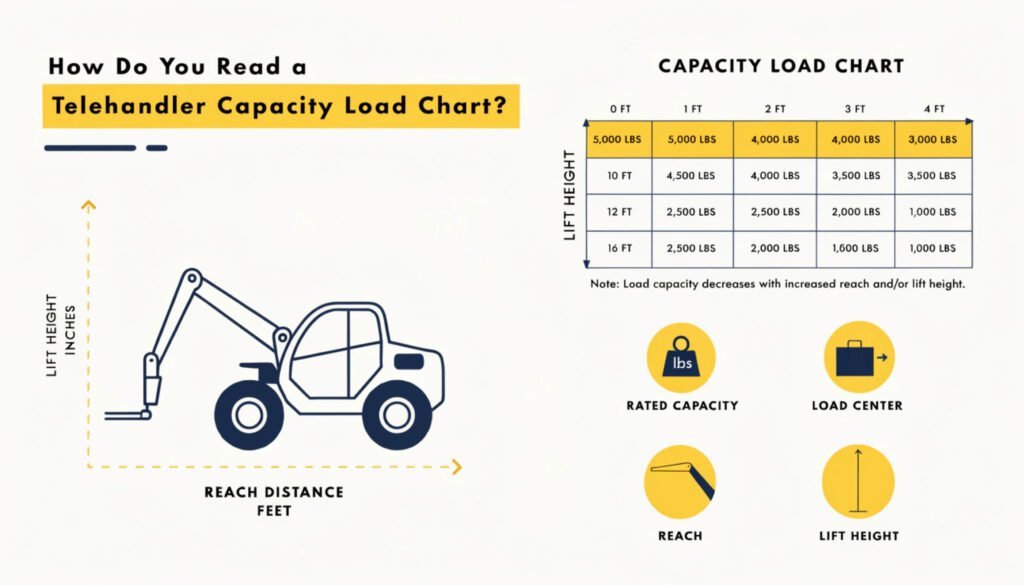
A load chart is a critical safety diagram that shows exactly how much weight a telehandler can safely lift at various boom heights and forward reaches. Always consult the specific chart for the machine and attachment combination you are using.
Dive Deeper: Mastering the Load Chart
A telehandler’s “rated capacity”—the big number often painted on the side, like 4 tons (or 8,000 lbs)—is a bit misleading. That number represents the maximum weight the machine can lift under ideal conditions: with the boom retracted as low and as close to the machine as possible. The moment you begin to raise or extend the boom, your actual lifting capacity decreases significantly. The load chart is your only guide to understanding these limits.
Let’s break down how to read one:
- The Vertical Axis (Y-axis): This shows the lifting height, usually measured in feet or meters from the ground to the bottom of the forks.
- The Horizontal Axis (X-axis): This represents the forward reach, measured in feet or meters from the front of the tires to the vertical centerline of the load.
- The Load Zones: The chart is divided into zones or curves, each labeled with a specific weight limit. To find your capacity, you first locate your required height on the Y-axis and your required reach on the X-axis. The point where they intersect will fall into a specific load zone. That zone’s value is your maximum safe lifting capacity for that specific position.
A Critical Factor: The Load Center
Load charts are calculated based on a standard load center, typically 24 inches (600mm). This means the chart assumes the center of gravity of your load is no more than 24 inches from the vertical face of the fork carriage. If you are lifting a long or awkwardly shaped object where the center of gravity is further out, your lifting capacity will be even lower than what the chart indicates.
Finally, and most importantly, you must subtract the weight of the attachment itself. If you are using a 1,000 lb grapple bucket on a machine that the chart says can lift 5,000 lbs at a certain reach, your actual material lifting capacity is only 4,000 lbs. This is where having an integrated manufacturer like us becomes a huge advantage. Our load charts are developed for our specific attachments, removing the guesswork for you.
2,What Telehandler Capacity Models Are Available?
The market is filled with options, from compact models to heavy-duty beasts. How do you know if you need a nimble 2.5-ton machine for your farm or a powerful 7-ton telehandler for your construction projects? The sheer variety can be overwhelming.
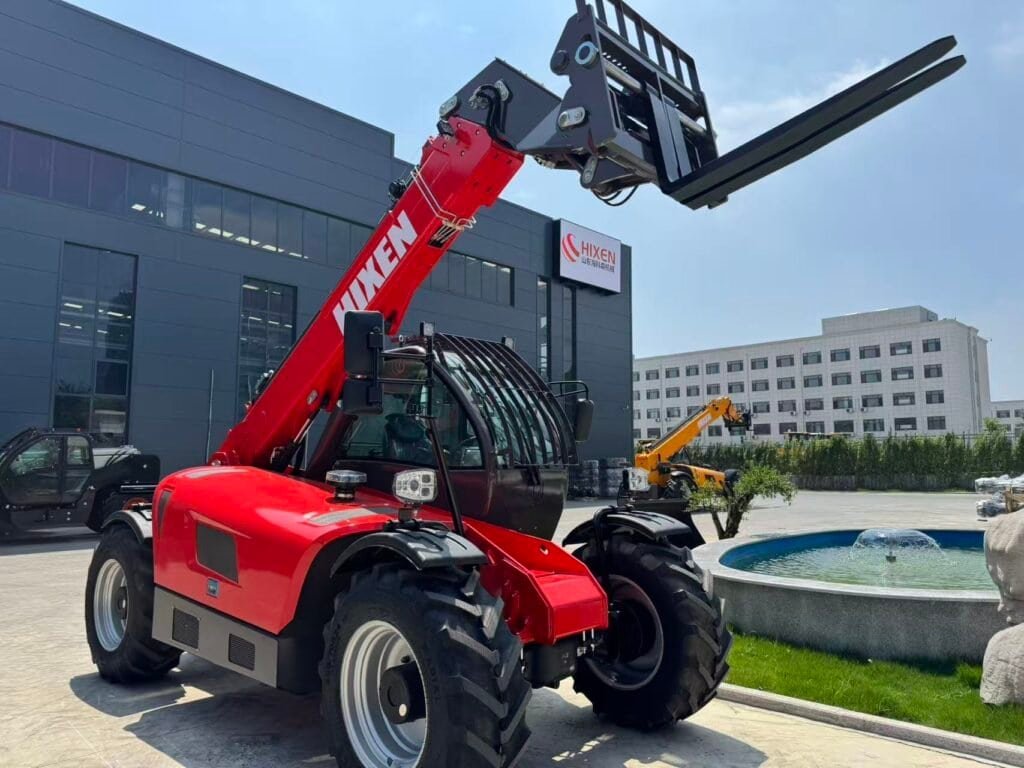
Telehandler capacity models typically range from compact 2.5-ton (5,500 lbs) units perfect for tight access sites, to versatile 4-ton (8,800 lbs) workhorses, and up to heavy-duty 7-ton (15,400 lbs) models for major industrial and construction tasks. Your choice depends entirely on the typical weight, size, and placement height of your daily loads.
Dive Deeper: Comparing Common Capacity Classes
As a manufacturer with over 15 years of export experience, we’ve seen how different industries gravitate towards specific capacity classes. Let’s compare the most common models we produce.
The Compact 2.5-Ton Telehandler
These machines are the champions of accessibility. With a lift capacity of around 2.5 tons, they are perfect for tasks where space is limited. Think residential construction, landscaping projects, small-scale farming, or navigating tight poultry houses. Their smaller footprint and tighter turning radius allow them to work where larger machines simply can’t go. They are excellent for moving pallets of sod, small loads of bricks, or feed bags.
The Versatile 4-Ton Telehandler
This is the “sweet spot” and the most popular telehandler capacity for a reason. A 4-ton machine, like our popular 10-meter HIXEN models, offers a fantastic blend of power and maneuverability. It’s the go-to choice for general construction sites, capable of lifting pallets of framing materials to the second or third story. In agriculture, it can easily handle large hay bales, stack pallets of seed, and load trucks. For rental fleets, the 4-ton class is a reliable workhorse that can meet the needs of a wide variety of customers.
The Heavy-Duty 7-Ton Telehandler
When the job demands serious muscle, the 7-ton models step up. These are the machines you’ll find on large-scale commercial construction sites, in industrial yards, and at ports. Their primary job is to lift heavy materials like precast concrete sections, large bundles of steel rebar, or heavy-duty equipment. Our 18-meter heavy-duty telehandlers are engineered for this kind of work, providing both immense lifting power and significant reach for placing materials on tall structures.
Custom Telehandler Capacity: The HIXEN OEM/ODM Advantage
What if your needs don’t fit neatly into these categories? This is where our core strength as a manufacturer shines. We offer full OEM/ODM (Original Equipment Manufacturer/Original Design Manufacturer) customization. If you need a specific capacity, a unique lift height, or a machine built to a certain width or weight for your application, we can engineer and build it for you. You don’t have to settle for an off-the-shelf solution that’s a compromise. We build the exact machine you need, right down to the color and branding.
3,How Do Attachments Affect Telehandler Capacity?
You’ve done your homework and selected a telehandler with the perfect rated capacity. But then you attach a specialized grapple, and suddenly you can’t lift what you thought you could. An incompatible or unexpectedly heavy attachment can completely undermine your machine’s performance and safety.
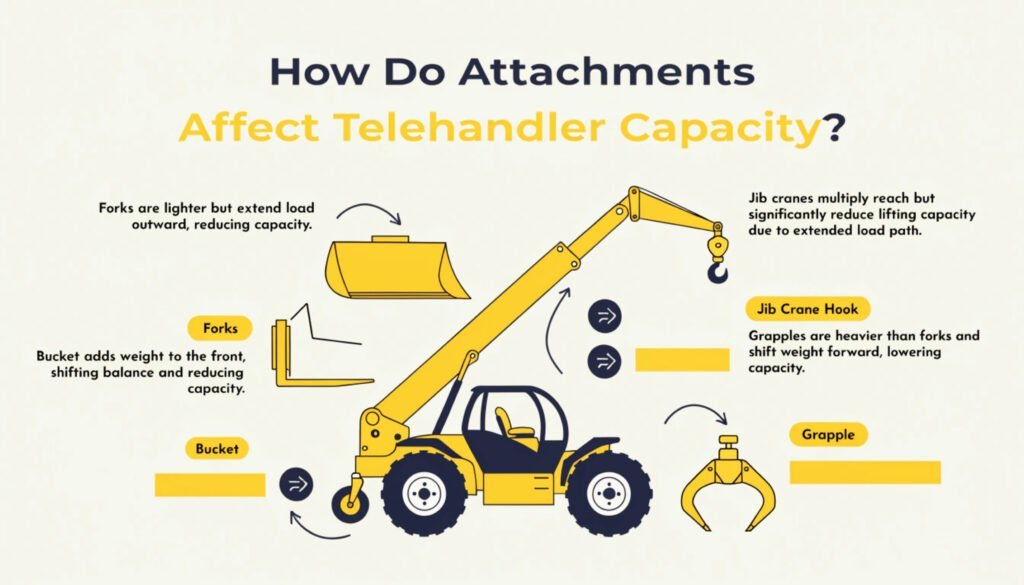
Every attachment has its own weight and a unique load center. This combination directly reduces the telehandler’s gross lifting capacity as shown on the load chart. To find your true, usable lifting power (the net capacity), you must always subtract the attachment’s weight from the chart’s value.
Dive Deeper: The Critical Link Between Machine and Tool
Thinking of attachments as an afterthought is a common mistake we see buyers make. The synergy between the telehandler and its attachment is crucial for both performance and safety.
The HIXEN Advantage: Integrated Design
As a factory that manufactures both telehandlers and a full range of attachments, we engineer them to work together from day one. This means:
- Perfect Hydraulic Match: The hydraulic flow and pressure of our telehandlers are precisely matched to the requirements of our attachments. This ensures you get smooth, predictable, and powerful performance, whether you’re using a simple bucket or a complex rotating grapple.
- Accurate Load Data: When you buy a HIXEN attachment for a HIXEN telehandler, the performance data is already calculated. We provide accurate information on how our attachments affect the machine’s telehandler capacity, removing dangerous guesswork.
- Guaranteed Fit: Our quick-attach systems are designed for a seamless and secure fit. There’s no need for modifications or concerns about sloppy connections that can lead to premature wear or failure.
Universal Compatibility for Mixed Fleets
We also understand that our customers, especially dealers and large contractors, often operate mixed fleets. That’s why our attachments are designed with universal quick-attach plates compatible with major brands like JCB, Manitou, and CAT. You can confidently source high-quality attachments from us, knowing they will integrate with your existing equipment. Explore our full range at our HIXEN Telehandler Attachments page.
Attachment Categories & Typical Applications
To help you find the right tool for the job, here is a quick guide to common attachment categories:
| Attachment Category | Typical Use Case | Best-Fit Industry |
|---|---|---|
| Buckets (General, Grapple) | Moving loose materials like soil, gravel, grain, manure | Agriculture, Construction, Landscaping |
| Forks & Carriages | Lifting pallets, lumber, pipe, building materials | Construction, Logistics, Warehousing |
| Grapples & Clamps | Handling logs, hay bales, pipes, scrap materials | Forestry, Agriculture, Recycling, Utilities |
| Lifting & Crane Jibs | Hoisting trusses, engines, and materials to height | Construction, Industrial Maintenance |
| Snow & Cleaning (Blades, Brooms) | Clearing snow from lots, cleaning job sites and roads | Municipal, Facilities Management, Agriculture |
| Specialty (Work Baskets, Bale Spears) | Lifting personnel for maintenance, handling specific bale types | Maintenance, Construction, Agriculture |
4,What Should I Ask a Manufacturer About Build Quality?
Sourcing heavy machinery from an overseas factory can feel like a leap of faith. How can you be sure you’re getting a durable, reliable machine that will stand up to years of hard work? You need to ask the right technical questions that go beyond the sales brochure.
When sourcing a telehandler directly from a factory, you must ask about the specific grade of steel used in the boom and chassis, the standards of the hydraulic hoses and fittings, the type of quick-attach coupler systems available, the production lead time, and the details of their after-sales support and spare parts availability.
Dive Deeper: Sourcing with Confidence from China
As a Chinese manufacturer with 15 years of successful export experience to over 20 countries, we believe in transparency. Here are the questions you should be asking us, or any manufacturer, to verify the quality and reliability of their machines.
1): Steel Grade and Durability
The longevity of a telehandler starts with its skeleton. Ask: “What grade of steel do you use?”
For our machines, we use high-strength Q355 manganese steel for the main chassis and structural components. For the most critical parts of the telescopic boom that undergo the highest stress, we use an even stronger grade like Q690. These advanced steel alloys provide superior strength and fatigue resistance compared to standard carbon steel, ensuring the machine can handle demanding cycles for years without cracking or deformation.
2): Hydraulic Systems
A telehandler’s hydraulic system is its lifeblood. Ask: “What standards do your hydraulic hoses and fittings meet?”
We use hydraulic components that meet international standards. This means that if a hose ever needs replacement, you can source a compatible part from a local supplier anywhere in the world. This is a critical detail for ensuring maximum uptime and ease of maintenance, especially for our dealer partners.
3): Quick-Attach Couplers and Customization
Compatibility is key. Ask: “What quick-attach systems do you offer?”
We offer several quick-attach coupler types to ensure our machines and attachments can integrate into your existing fleet. As part of our OEM/ODM service, we can configure our telehandlers with the specific mounting system you use, whether it’s for JCB, Manitou, CAT, or another brand.
4): Production Lead Time & Logistics
You need a clear delivery timeline. Ask: “What is your production lead time?”
Our streamlined production process allows for a standard lead time of just 7-15 days for our regular models. For fully custom OEM/ODM orders, the lead time is typically 15-30 days. With our extensive export experience, we manage all aspects of factory-to-port logistics, making the process smooth and predictable for our international clients.
5): After-Sales & Spare Parts Support
The sale is just the beginning of our relationship. Ask: “How do you handle after-sales support and spare parts?”
We provide comprehensive technical support and maintain a ready stock of all critical spare parts. We can ship replacement parts quickly to anywhere in the world to minimize your downtime. Our commitment to our customers and dealers extends long after the machine arrives at your site.
Frequently Asked Questions
How much does a 7-ton telehandler cost?
The price of a 7-ton telehandler varies significantly based on lift height, engine specifications, included attachments, and any custom modifications. Because we are a factory, we offer direct pricing. Please contact our team for a detailed quote based on your specific requirements.
Can I get a telehandler in my company’s colors?
Absolutely. Our OEM/ODM service includes full customization, from performance specifications to aesthetics. We can paint your telehandler in your company’s specific color scheme and apply your branding and logos directly at the factory for a professional, integrated look.
What is the difference between rated capacity and capacity at reach?
Rated capacity is the absolute maximum weight a telehandler can lift when the boom is fully retracted and at a low angle. Capacity at reach is the (lower) amount of weight it can lift when the boom is extended or raised. You must always refer to the machine’s load chart to find the safe capacity for any given reach and height.
How long does it take to ship a telehandler from your factory in China?
Our production time is very fast, typically 7-15 days for standard models and 15-30 days for custom builds. The ocean shipping time will depend on your final destination port. We have over 15 years of experience coordinating international freight and can provide you with an accurate shipping timeline.
Conclusion
Choosing the correct telehandler capacity is more than just picking the biggest number; it’s a calculated decision that impacts your business’s safety, efficiency, and profitability. By understanding how to read a load chart, evaluating the different model classes, and appreciating the critical impact of attachments, you can make an informed choice. Remember that true performance comes from the synergy between the machine and its tool, a principle that drives our integrated manufacturing process. The right questions about build quality, materials, and support will ensure you invest in a machine built to last.
At HIXEN, we don’t just sell telehandlers; we build customized lifting solutions. With our in-house attachment manufacturing, extensive OEM/ODM capabilities, and commitment to robust engineering, we provide machines that are perfectly tailored to your needs.
Ready to find the perfect telehandler capacity for your business? Contact our engineering team today to discuss your specific requirements and get a customized, factory-direct quote.

