
Struggling to budget for your next equipment purchase? If you’re looking for a new machine, this telehandler price guide is essential, but you’ve likely discovered that quotes vary wildly between suppliers. You see some telehandlers listed at what seems like a bargain, while others cost tens of thousands more, leaving you confused. The reason for this disparity is that a telehandler is not a one-size-fits-all product; its price is a complex equation.
The average price for a new telehandler in 2026 can range from $40,000 for a compact model to over $250,000 for a heavy-duty or rotating unit. The final cost depends heavily on lifting capacity, lifting height, engine brand, hydraulic system, included attachments, and the manufacturer’s brand reputation. Therefore, a specific price can only be determined with a detailed quote based on your exact requirements.

Understanding this price variation is the first step toward making a smart investment. This article will break down the costs associated with different models, explore the key factors that influence the final price, and guide you on how to secure a quote that truly reflects the value you need.
1,How Much Does a Telehandler Cost in 2026?
Are you trying to figure out a realistic budget for a new telehandler? You’ve probably noticed that getting a straight answer on price is difficult. Some suppliers offer seemingly low prices, while others quote figures that are tens of thousands of dollars higher. Why the huge difference?
A telehandler isn’t a standardized commodity with a fixed price tag. The final cost is a blend of its core specifications, the quality of its components, and the brand behind it. This is why a simple question like “how much for a telehandler?” rarely gets a simple answer.

Diving Deeper into Telehandler Cost Factors
As a manufacturer with over 15 years of experience in engineering and exporting machinery like telehandlers, I’ve helped countless buyers navigate this process. At HIXEN, we believe an informed customer is our best partner. The price you are quoted is directly influenced by a combination of critical factors.
Here are the main components that determine the final cost:
- Lifting Capacity: The maximum weight the machine can lift. A 5-ton machine will naturally cost more than a 3-ton machine due to a more robust frame, boom, and axles.
- Lifting Height: How high the telehandler can place a load. A boom that extends to 18 meters requires more complex engineering and stronger materials than one that reaches 7 meters.
- Boom Design: The structure and number of sections in the telescopic boom.
- Engine Brand and Emission Standard: A premium engine from a brand like Cummins or Perkins will carry a higher price than a standard engine. Furthermore, compliance with strict emission standards (like EU Stage V or EPA Tier 4 Final) adds significant cost due to advanced after-treatment systems.
- Sistema idraulico: The efficiency and responsiveness of the machine depend on its hydraulics. A load-sensing system with components from a brand like Danfoss will be more expensive but offers superior performance.
- Transmission and Axles: The powertrain components must be matched to the machine’s capacity and intended use, affecting both performance and price.
- Allegati: The quote may or may not include attachments like forks, buckets, or jibs. Each additional tool adds to the total cost.
- Manufacturer and Brand: An established European brand often includes a price premium for its reputation and extensive dealer network, whereas direct-from-factory manufacturers like us can often offer more competitive pricing.
This telehandler price guide is designed to demystify these variables, helping you understand what you’re paying for and ensuring you invest in a machine that delivers long-term value for your business.
2,Telehandler Price by Type: What Are the Different Price Ranges?
Are you confused about which type of telehandler fits your budget and needs? The market is segmented into different categories, each with a distinct price range and application focus. Picking the right one prevents you from overpaying for capacity you don’t need or under-investing in a machine that can’t handle the job.
The price of a telehandler is closely tied to its type and size. Compact models are the most affordable, standard models offer a balance of price and versatility, while heavy-duty and rotating models represent the highest investment due to their specialized capabilities and complex engineering.

Diving Deeper into Telehandler Types and Costs
Let’s break down the main categories to give you a clearer picture of where your budget might land.
H3: Compact Telehandler Price
Compact telehandlers are the entry point into the market. With their smaller body design and lower lifting capacities (typically 2.5 to 3 tons), they are designed for agility and access.
- Key Features: Compact footprint, excellent maneuverability, lower initial purchase cost.
- Common Applications: Small construction sites, agricultural farms, warehouse logistics, and landscaping projects where space is tight.
- Price Consideration: These models are ideal for buyers with a limited budget or those whose workload doesn’t justify a larger, more powerful machine. They are easier and cheaper to transport between job sites.
H3: Standard Telehandler Price
This is the most popular and versatile category, covering the sweet spot for many businesses. Standard telehandlers are the workhorses of construction sites and large farms.
- Key Features: Lifting capacities typically range from 3 to 5 tons, with various lifting height options (e.g., 7m, 10m, 14m). They support a wide array of attachments, making them incredibly versatile.
- Common Applications: General construction, material handling, industrial projects, agricultural tasks, and equipment rental fleets.
- Price Consideration: These machines offer the best balance of performance, versatility, and cost. Models in our HIXEN lineup, such as the HX3007, HX3510, and HX4014, fall into this category, providing reliable solutions for general contractors, farmers, and equipment dealers.
H3: Heavy-Duty Telehandler Price
When the job demands serious muscle, heavy-duty telehandlers step in. These machines are built for power and endurance.
- Key Features: Higher lifting capacities (5 tons and above), a stronger and heavier chassis, a more robust boom structure, and uprated hydraulic and transmission systems to handle intense loads.
- Common Applications: Heavy construction, large-scale industrial material handling, mining support, and large agricultural operations.
- Price Consideration: A significant increase in lifting capacity means a corresponding increase in manufacturing cost. The frame, axles, and boom must all be engineered to a higher standard, which is reflected in the final price.
H3: Rotating Telehandler Price
Rotating telehandlers, or “rotos,” are the most advanced and expensive type. They combine the functions of a telehandler, a crane, and an aerial work platform.
- Key Features: A turret that allows for 360-degree continuous rotation of the upper structure. This enables precise load placement without repositioning the machine. They are often equipped with outriggers for stability.
- Common Applications: Complex construction projects, high-rise building, and job sites where multiple lifting tasks are required from a single position.
- Price Consideration: The rotating platform, sophisticated hydraulic system, and advanced safety features make these machines significantly more expensive than fixed-frame telehandlers of a similar capacity.
3,Telehandler Price by Lifting Capacity?
Wondering how much more you’ll pay as lifting capacity increases? It’s a critical question, as capacity is one of the biggest drivers of a telehandler’s price. A machine designed to lift 5 tons requires a fundamentally different level of engineering than one built for 3 tons.
Generally, the higher the lifting capacity, the higher the initial purchase price. This is because increased capacity necessitates a stronger chassis, a more robust boom, more powerful hydraulics, and heavier-duty axles, all of which increase manufacturing costs.
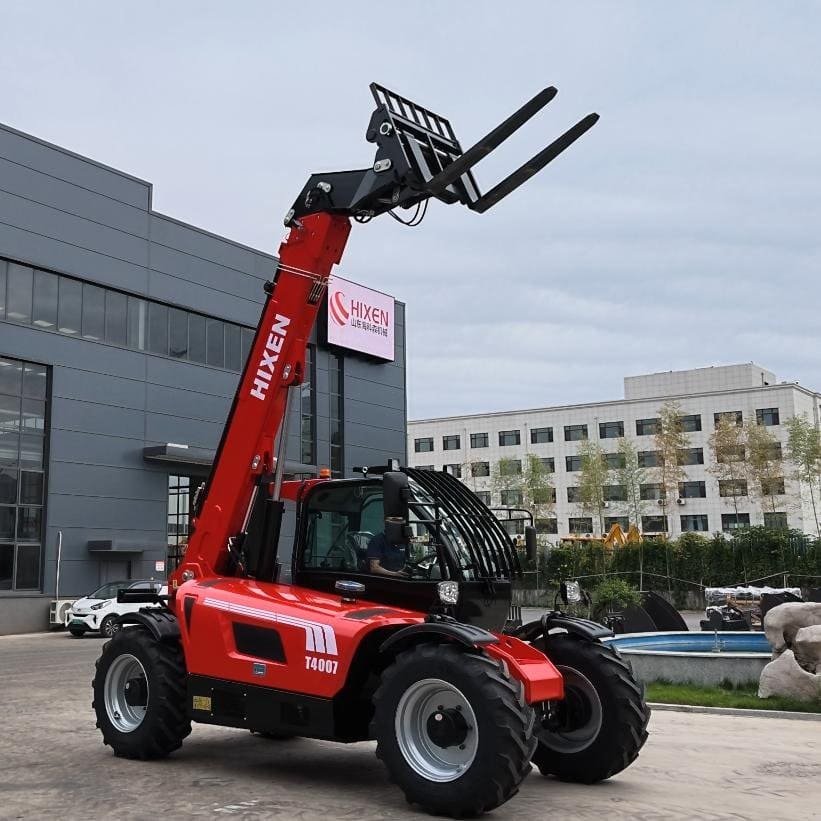
Diving Deeper into Capacity and Cost
While it’s a good rule of thumb that more tons equal more dollars, the relationship isn’t always linear. You cannot look at capacity in a vacuum. A complete telehandler price guide must consider how capacity interacts with other specifications.
Here’s a general breakdown of how we categorize telehandlers by their lifting capacity and primary use cases:
| Equipment Category | Common Lifting Capacity | Applicazioni primarie |
|---|---|---|
| Compact Telehandler | 2.5 – 3 Tons | Small construction sites, farms, warehousing |
| Medium Telehandler | 3 – 4 Tons | General construction, agriculture, material handling |
| Heavy Telehandler | 5 – 6 Tons | Heavy-duty construction, industrial projects |
| Large Telehandler | 7+ Tons | Large-scale engineering and heavy-load operations |
It’s tempting to think that a 4-ton machine is a 4-ton machine, but that’s an oversimplification. Maximum lifting capacity is not the only factor that determines telehandler price.
Consider two telehandlers, both rated for 4 tons:
- Model A: Has a maximum lifting height of 7 meters.
- Model B: Has a maximum lifting height of 17 meters.
Even with the same lifting capacity, Model B will be significantly more expensive. Its multi-stage boom must be longer and stronger to handle the same weight at a much greater extension. This requires a more complex boom structure, a more powerful hydraulic system to extend and retract it, and a heavier counterweight and chassis to maintain stability.
When I talk to potential buyers, I always stress the importance of looking at the load chart. A telehandler’s lifting capacity decreases as the boom extends and elevates. The critical question isn’t just “How much can it lift?” but “How much can it lift at the height and reach my job requires?” Choosing a machine based solely on its maximum capacity rating can lead to buying a unit that is unsafe or inadequate for your most common tasks.
4, 10 Factors That Affect Telehandler Prices?
Are you trying to understand why two seemingly similar telehandlers have drastically different prices? The sticker price is the result of a dozen engineering and business decisions. Knowing these factors empowers you to compare quotes intelligently and ensure you are paying for features you actually need.
Beyond capacity and brand, at least ten key factors directly influence the final cost of a telehandler. These include the lifting height, engine brand, hydraulic system quality, transmission type, attachments, and even the shipping terms.

Diving Deeper into the Top 10 Price Factors
This section of our telehandler price guide breaks down the elements that contribute to the final quote. When you request a price, a manufacturer is calculating the cost of each of these components.
- Lifting Capacity: As discussed, a higher tonnage rating requires a more robust frame, boom, axles, and counterweight, directly increasing material and manufacturing costs.
- Lifting Height and Boom Length: A longer, multi-stage boom is more complex and expensive to engineer and build than a shorter one. A 14-meter or 18-meter telehandler has a fundamentally different structure than a 7-meter model, even at the same capacity.
- Engine Brand and Emissions: The engine is the heart of the machine. A world-renowned brand like Cummins O Perkins will cost more than a standard domestic brand like Yuchai O Yunnei. Additionally, meeting strict emissions standards (e.g., EU Stage V) requires expensive diesel particulate filters (DPF) and selective catalytic reduction (SCR) systems, adding thousands to the price.
- Sistema idraulico: Performance lives in the hydraulics. A basic system will get the job done, but a high-efficiency, load-sensing system with components from premium brands like Danfoss will offer smoother, faster, and more precise operation at a higher cost.
- Transmission: The type and brand of the transmission affect performance and price. A sophisticated powershift or hydrostatic transmission offers better control and efficiency than a more basic mechanical setup.
- Axles and Braking System: The axles must support the machine’s total weight plus its maximum load. Heavy-duty axles with advanced braking systems (like wet brakes) are crucial for safety and durability, especially in demanding applications, and they cost more.
- Allegati: A base price often includes only a standard fork. Every additional attachment—such as a general-purpose bucket, 4-in-1 bucket, bale clamp, jib, lifting hook, or work platform—is an added cost. Always clarify what is included in your quote.
- Cab and Comfort Options: Operator comfort is not just a luxury; it’s a productivity feature. An enclosed cab with air conditioning, heating, an adjustable air suspension seat, and a rear camera will be more expensive than a basic open canopy.
- Brand and Manufacturer: A well-known European brand invests heavily in R&D, marketing, and a global dealer network, and these costs are factored into their pricing. As a direct manufacturer, HIXEN can often provide a similar or better specification for a more competitive price by streamlining the supply chain.
- Shipping and Destination (Incoterms): For international buyers, the quoted price is heavily dependent on trade terms. A FOB (Free On Board) price only covers the cost of the machine and its delivery to the departure port. A CIF (Cost, Insurance, and Freight) price also includes ocean freight and insurance to your destination port. You cannot compare a FOB price from one supplier to a CIF price from another without accounting for these significant additional costs.
5, Chinese Telehandler vs European Brands: What Is the Price Difference?
Is a Chinese telehandler a better value than one from a European brand like Manitou or JCB? This is one of the most common questions I get from international dealers and construction companies. The price difference can be substantial, but it’s crucial to understand why.
Typically, a Chinese telehandler offers a more competitive factory-direct price compared to its European counterpart with similar specifications. This difference arises from lower manufacturing costs, flexible configuration options, and a more direct sales model, whereas European brands include a premium for their established brand reputation and extensive dealer networks.

Diving Deeper into the Brand and Origin Price Gap
The decision between a Chinese and a European telehandler shouldn’t be based on price alone. It’s about finding the best value, which means comparing the complete package: specifications, component quality, warranty, and after-sales support.
European Telehandler Brands
Brands like Manitou, JCB, Merlo, and Dieci have built global reputations over decades. When you buy from them, you are investing in:
- Established International Reputation: Decades of market presence and proven product lines.
- Mature Product Ranges: Highly refined models with a long history of performance in Western markets.
- Extensive Dealer Networks: Local dealers provide sales, service, and parts support in many countries.
- Established After-Sales Systems: Well-defined warranty processes and readily available service technicians.
However, this comes at a cost. The price of a European machine includes a brand premium, the overhead of their global sales and marketing infrastructure, and the margins for national distributors and local dealers. Their configurations are also often standardized for Western markets, which may include features or emission standards you don’t need but still have to pay for.
Chinese Telehandler Manufacturers
In recent years, Chinese manufacturers like HIXEN have rapidly closed the technology and quality gap. Our competitive advantage lies in a different approach:
- Competitive Factory-Direct Pricing: By selling directly or through regional distributors, we reduce the layers of middlemen, passing the savings on to you. This is a key part of any telehandler price guide.
- Flexible Configurations: We can tailor a machine to your exact needs. Need a simpler engine for a market without strict emission laws? We can do that. Need a specific attachment? We can build it. This avoids paying for over-engineered features.
- Multiple Engine Options: We offer a range of reliable engines to balance cost and performance based on your local requirements and preference.
- OEM and Private-Label Opportunities: We work with dealers and importers to build machines under their own brand, offering a path to market without massive R&D investment.
The most important takeaway is this: Buyers should compare actual specifications, component brands, manufacturing quality, warranty, and after-sales support rather than comparing prices alone. I’ve seen customers choose a cheaper machine from a trading company only to find it used subpar components and had zero after-sales support. A reputable manufacturer will be transparent about the brands of their engines, pumps, valves, and axles.
At HIXEN, we provide factory-direct solutions that empower importers, dealers, and end-users to get the most machine for their money by focusing on what truly matters for their application.
6, Hidden Costs to Consider When Buying a Telehandler?
Worried that the initial quote for a telehandler is just the tip of the iceberg? You’re right to be cautious. A low sticker price can be appealing, but it often hides other expenses that can significantly inflate your total cost of ownership.
Beyond the purchase price, you must budget for hidden costs such as international shipping, import duties, taxes, additional attachments, spare parts, ongoing maintenance, and operator training. Ignoring these can turn a seemingly good deal into a costly mistake.

Diving Deeper into Total Cost of Ownership
As a manufacturer who exports globally, I always advise my clients to look at the total picture. Here are the most common “hidden” costs you need to factor into your budget. This is a critical part of a complete telehandler price guide.
- Shipping and Freight: If you’re importing, ocean freight is a major expense. The cost varies based on the shipping line, route, container size (20ft, 40ft, or flat rack), and port congestion. You also have to account for terminal handling charges (THC) at both the departure and destination ports.
- Import Duties and Taxes: Every country has its own import tariff schedule. This could be a percentage of the machine’s CIF value. On top of that, you may have to pay a Value Added Tax (VAT) or Goods and Services Tax (GST). I’ve seen duties add anywhere from 5% to 25% to the final cost.
- Customs Clearance and Port Fees: You will need a customs broker to handle the import declaration paperwork. There will also be port storage fees (demurrage) if the machine isn’t picked up promptly.
- Additional Attachments: Does the quote include all the tools you need? If you require a bucket, a jib, or a bale clamp in addition to the standard forks, these will be extra. Buying them later can be more expensive than bundling them with the initial purchase.
- Initial Spare Parts Package: To minimize downtime, it’s wise to purchase a spare parts package with the machine. This typically includes essential filters (oil, fuel, air, hydraulic), belts, and other common wear items for the first year of operation.
- Ongoing Maintenance: Telehandlers require regular servicing. This includes the cost of hydraulic oil, engine oil, coolant, and grease. The service interval and cost should be factored into your operational budget.
- Operator Training: A telehandler is a powerful and complex piece of equipment. Proper training is not just a recommendation; it’s a critical safety requirement. If your team is not experienced with the specific model, you must budget for professional training.
- Local Service and Support: If you buy directly from an overseas manufacturer, who will service the machine? You may need to establish a relationship with a local hydraulic and diesel mechanic. While we provide extensive technical documentation and remote support, having local hands-on help is invaluable.
When comparing quotes, ask suppliers to be explicit about what is included. A transparent partner will help you understand these costs upfront.
7, How to Get an Accurate Telehandler Quote?
Frustrated by vague price estimates from suppliers? If you simply ask, “How much is a telehandler?” you’re likely to get a wide-ranging, unhelpful answer. To get a quote you can actually use for budgeting and comparison, you need to provide specific details.
To get an accurate telehandler quote, you must provide the supplier with your specific requirements. This includes the required lifting capacity, lifting height, engine preferences, a list of necessary attachments, and the final destination country and port.

Diving Deeper into the Quoting Process
From my experience on the manufacturing side, the more information you give me, the better I can serve you. A detailed request shows that you are a serious buyer and allows me to configure a machine that perfectly matches your needs and budget, without including features you won’t use.
Before you contact a supplier, prepare the answers to these questions:
- Step 1: What is your required lifting capacity?
Be specific. Do you need to lift 3 tons, 3.5 tons, 4 tons, or more? This is the first and most important piece of information. - Step 2: What is your required lifting height?
How high do you need to place materials? Are your typical jobs at 7 meters, 10 meters, 14 meters, or higher? This determines the boom structure. - Step 3: What are your engine requirements?
Do you have a preferred engine brand (e.g., Cummins, Perkins)? More importantly, what are the emission regulations in your country (e.g., Euro 3, Euro 5, EPA Tier 4)? This is non-negotiable for legal importation in many regions. - Step 4: Which attachments do you need?
List every tool you require. Will you need a standard pallet fork, a grain bucket, a log grapple, or a personnel work platform? Don’t assume anything is included. - Step 5: What is your destination country and port?
This is essential for calculating shipping costs and ensuring the machine’s configuration complies with local regulations. - Step 6: What trade terms do you prefer?
Do you want a quote for EXW (Ex Works), FOB (Free On Board), or CIF (Cost, Insurance, and Freight)? This clarifies who is responsible for shipping costs and risk. A CIF quote is the most comprehensive for budgeting your landed cost.
When you send an inquiry with this level of detail, you signal to the manufacturer that you’ve done your homework. In return, you will receive a precise, actionable quote that can be easily compared with others. The goal is to compare apples to apples, and that starts with a detailed request.
8, HIXEN Telehandler: Factory-Direct Solutions for Different Budgets
Are you looking for a telehandler that balances cost, performance, and quality? As a direct manufacturer, we offer a transparent and flexible alternative to traditional dealer networks. This section of our telehandler price guide explains how we cater to different budgets and needs.
HIXEN provides factory-direct telehandlers, allowing you to bypass dealer markups and communicate your needs directly with the engineers. With over 15 years in construction machinery manufacturing, we offer a wide range of models and configurations to create a solution that fits your specific application and budget.

Diving Deeper into the HIXEN Advantage
We built our business by partnering with importers, dealers, and end-users who need reliable equipment without the inflated price tag. Here’s how we deliver value:
1. Direct Manufacturer Communication
When you work with HIXEN, you’re not talking to a salesperson in a showroom; you’re communicating with the source. This direct line ensures your technical requirements are understood and implemented correctly. It also means we can provide competitive, factory-direct pricing.
2. Multiple Models and Configurations
We know that one size does not fit all. Our product lineup is designed to cover a wide spectrum of needs and budgets, from compact units to heavy-lifters:
- Compact Models: The agile HX2506 is perfect for tight spaces.
- Standard Models: Our versatile HX3007, HX3507, HX3510, HX4014, and HX4018 are the core of our range, popular with construction and agricultural clients.
- Heavy-Duty Models: The powerful HX6022 is designed for the most demanding jobs.
3. Flexible Engine Options
We offer engine configurations to match your market’s emission standards and your performance-to-cost preference. Whether you need a top-tier Cummins O Perkins engine for a highly regulated market or a reliable Yuchai O Yunnei engine for cost-effectiveness, we can build it. All configurations are confirmed per your specific order.
4. Customized Attachments
Why pay for a package with tools you’ll never use? We provide a wide range of attachments—including forks, various buckets, bale clamps, jibs, hooks, and work platforms—and you only purchase what your jobs demand.
5. Export and After-Sales Support
We have extensive experience exporting our machines worldwide. We provide comprehensive technical documentation, detailed operation manuals, and robust spare parts support. We facilitate third-party inspections before shipment for your peace of mind and offer a clear warranty policy. Our goal is to build long-term partnerships, and that means supporting you long after the sale.
At HIXEN, we focus on the total value of your investment, not just the initial price. We want to ensure you get a machine that is fit for purpose, reliable, and supported for years to come.
9, Frequently Asked Questions About Telehandler Prices
How much does a new telehandler cost?
A new telehandler’s price varies significantly, from around $40,000 for a small, compact model to over $250,000 for a large-capacity or rotating telehandler. The final cost is determined by its lifting capacity, height, engine, brand, and included features. A detailed quote based on your needs is the only way to get a precise figure.
How much does a used telehandler cost?
A used telehandler can be 30-60% cheaper than a new one, but its price depends heavily on the brand, year, total operating hours, maintenance history, and overall condition. While the initial cost is lower, be sure to budget for potential repairs and a shorter operational lifespan.
Why are some telehandlers so much more expensive than others?
Price differences are due to variations in specifications and quality. A more expensive machine typically has a higher lifting capacity, greater reach, a premium engine brand (like Cummins), advanced load-sensing hydraulics, a better warranty, and the backing of an established global brand with a large service network.
Are Chinese telehandlers cheaper than European brands?
Generally, yes. Chinese manufacturers often offer more competitive pricing due to lower labor costs and a factory-direct sales model. However, buyers should compare detailed specifications, component brands (engine, hydraulics), and warranty support, not just the price tag, to ensure they are getting a good value.
What is the cheapest telehandler to buy?
The cheapest new telehandlers are typically compact models with a lower lifting capacity (around 2.5 tons), a modest lifting height (under 7 meters), a basic open cab, and a standard engine configuration. While affordable, ensure its capabilities match your job requirements to avoid purchasing a machine that is underpowered for your needs.
Conclusion
Navigating the world of equipment purchasing can be complex, but this telehandler price guide should give you the confidence to make an informed decision. The key takeaway is that the “right” price is not simply the lowest number. A telehandler’s true cost is a function of its lifting capacity, height, component quality, and the support you receive from the manufacturer. The cheapest machine is rarely the best deal if it can’t perform the job safely or if it lacks reliable after-sales support. The best value comes from a machine that perfectly balances your application’s demands with your budget.
As a manufacturer, we believe in empowering our clients with knowledge. By understanding the factors that shape telehandler prices—from engine choices to shipping terms—you can compare quotes effectively and invest in equipment that will deliver a strong return for years to come.
If you are looking for a reliable, factory-direct telehandler tailored to your specific needs, our team at HIXEN is ready to help. Contattaci today to discuss your requirements, and we will provide you with a detailed, transparent quote with no hidden costs.
