
Struggling to move heavy materials to high or hard-to-reach places on your job site? You may find that traditional forklifts lack the necessary height and terrain adaptability, while larger cranes are too cumbersome and expensive for daily material handling. You need a versatile, powerful, and efficient solution that bridges this gap. This is where a fixed telehandler becomes an indispensable asset for your construction or agricultural operations.
A fixed telehandler, also known as a fixed boom or fixed frame telehandler, is a versatile material handling machine equipped with a telescopic boom on a rigid, non-rotating chassis. It combines the lifting height of a crane with the material handling agility of a forklift, making it ideal for lifting, moving, and placing materials at significant heights and forward reaches.

This unique combination of features has made the fixed telehandler a go-to piece of equipment across numerous industries. In this guide, we’ll dive deep into everything you need to know, from its core features and applications to how to select the perfect model for your business needs. Let’s explore why this machine might be the missing piece in your equipment fleet.
1,Why Are Fixed Telehandlers So Popular in Construction and Agriculture?
Are you frequently facing challenges with lifting materials to upper floors, stacking hay bales high in a barn, or navigating rough terrain with a heavy load? These are common problems on construction sites and farms. Your team needs to move building supplies, load and unload pallets from trucks, or transport feed across uneven ground efficiently and safely.
A standard forklift can’t reach high enough, and a crane isn’t practical for constant, flexible movements. This operational gap is precisely where the fixed telehandler demonstrates its value. It’s not just another lifter; it’s a multi-purpose workhorse designed for modern job site demands.
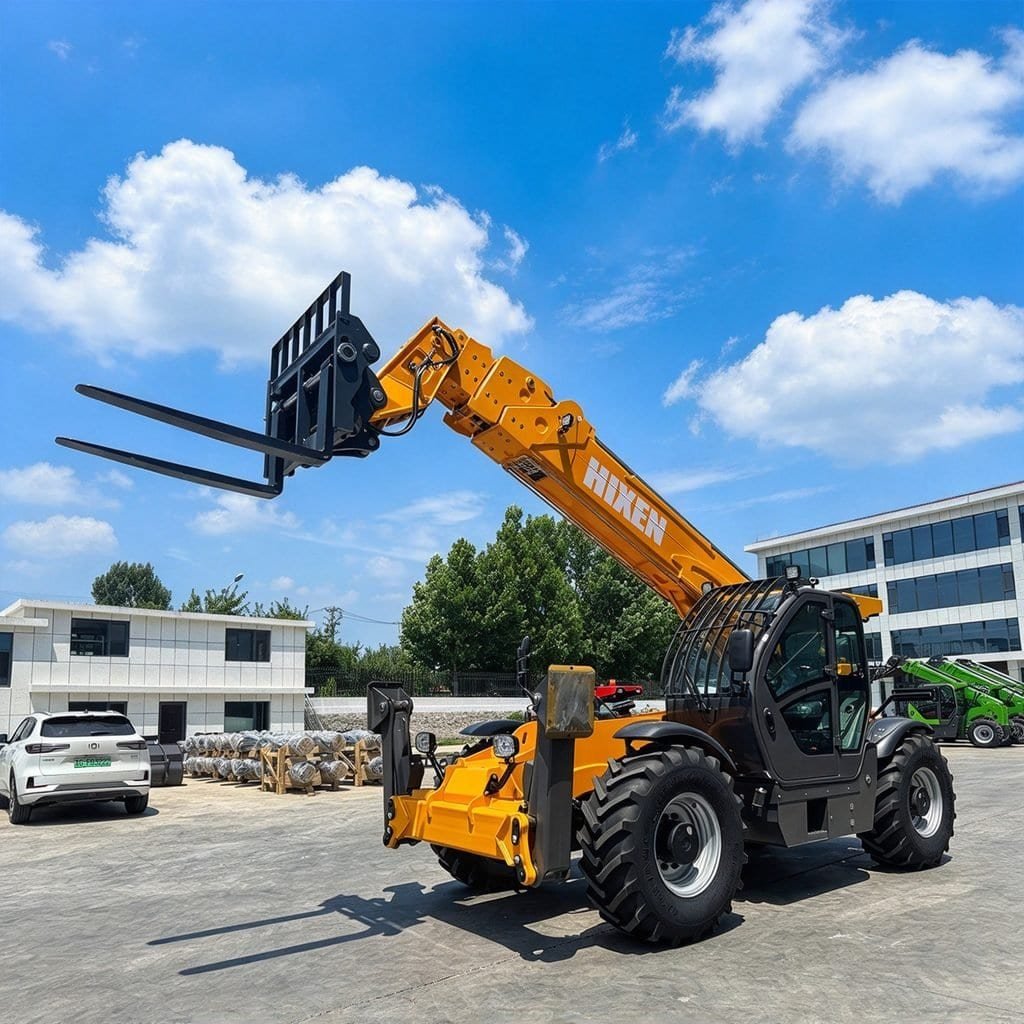
With a telescopic boom, four-wheel drive, and the ability to use interchangeable attachments, a fixed telehandler combines lifting height, forward reach, and job-site flexibility into one robust machine. This versatility is the primary reason for its widespread popularity.
Dive Deeper: The All-in-One Solution
The core appeal of a fixed telehandler lies in its ability to perform tasks that would otherwise require multiple machines.
- In Construction: On a multi-story building project, a fixed telehandler can pick up a pallet of bricks from a delivery truck, drive over muddy ground to the building’s base, and then extend its boom to place the pallet on the second or third floor. It acts as a forklift, an all-terrain vehicle, and a low-level crane all at once. This consolidation of roles saves time, reduces the number of machines needed on-site, and lowers operational costs.
- In Agriculture: For a farmer, harvest season means moving thousands of hay bales. A fixed telehandler with a bale clamp attachment can easily pick up, transport, and stack bales much higher and more densely than a tractor with a front-end loader. Its forward reach allows it to place bales in the back of a shed or stack them in tall, stable pyramids, maximizing storage space. The same machine can later be fitted with a bucket to move grain or a fork to unload pallets of fertilizer.
This adaptability makes the fixed telehandler a high-return investment. Instead of purchasing, fueling, and maintaining three separate machines, a business can rely on one highly capable unit. From our experience at HIXEN, we see customers in over 50 countries leveraging this versatility to boost productivity and streamline their workflows. They appreciate having a single machine that can handle lifting, loading, and transport across challenging environments.
2,What Is a Fixed Telehandler?
Have you ever wondered what exactly distinguishes a fixed telehandler from other lifting equipment? The name itself can be slightly misleading, so it’s important to clarify what “fixed” really refers to.
UN fixed telehandler is a material handling vehicle featuring a telescopic boom mounted on a rigid, non-rotating chassis. The term “fixed” refers to the machine’s frame; the upper structure (cab and boom) does not rotate 360 degrees relative to the undercarriage, unlike a rotating telehandler.

The boom itself is anything but fixed—it can be raised, lowered, and extended telescopically to reach significant heights and distances. This is the machine’s key functional advantage.
Dive Deeper: The Anatomy of a Fixed Telehandler
To fully understand how a fixed telehandler works, let’s break down its essential components. I’ve found that when our clients understand the machine’s structure, they can make much more informed decisions about configuration.
The primary parts of a fixed telehandler include:
- Telescopic Boom: The most critical component. It consists of multiple sections that extend and retract to provide vertical and horizontal reach.
- Châssis: The machine’s heavy-duty frame, which supports all other components. Its “fixed” nature provides stability during lifting operations.
- Cab: The operator’s compartment, which can be open (canopy) or enclosed. Modern cabs are designed for safety and ergonomics, often featuring ROPS (Roll-Over Protective Structure) and FOPS (Falling Object Protective Structure).
- Moteur: The power source, typically a diesel engine from brands like Cummins, Perkins, or Yuchai. The engine powers both the drivetrain and the hydraulic system.
- Hydraulic System: The heart of the machine’s lifting capability. It powers the boom’s lift, extension, and tilt functions, as well as the steering and any powered attachments.
- Transmission and Axles: These components deliver power to the wheels. Most fixed telehandlers feature four-wheel drive and multiple steering modes for superior maneuverability on rough terrain.
- Attachments: The tools connected to the end of the boom, such as forks, buckets, or jibs. These are typically interchangeable, allowing one machine to perform many different jobs.
The key takeaway is that the “fixed” design prioritizes stability and structural simplicity. The operator repositions the entire machine to change the boom’s direction, similar to driving a car or a forklift. This design is robust, reliable, and perfectly suited for the vast majority of material handling tasks in construction and agriculture.
3,Key Features of a Fixed Telehandler?
When evaluating a piece of equipment, what specific features should you look for? For a fixed telehandler, its value comes from a powerful combination of reach, strength, and adaptability.
The core features that make a fixed telehandler so effective are its telescopic boom, strong lifting capacity, all-terrain capability, and compatibility with multiple attachments. These elements work together to create a machine that delivers exceptional performance.

Let’s break down these defining characteristics to understand how they contribute to on-site productivity.
Dive Deeper: A Breakdown of Core Capabilities
Understanding these features in detail is crucial for any potential buyer or operator. In my years of helping clients specify their machines, I’ve seen that a clear grasp of these six points leads to the best purchasing decisions.
1. Telescopic Boom for Extended Reach
The signature feature of any telehandler is its boom. Unlike a forklift’s vertical mast, the telescopic boom provides both height and forward reach. This allows an operator to place materials over obstacles, deep inside a structure, or onto high scaffolding. This capability is invaluable for tasks like placing roof trusses, loading the far side of a flatbed truck, or reaching over a trench.
2. Strong Lifting Capacity
Fixed telehandlers are designed to lift heavy loads. Models range from smaller 2.5-ton units to heavy-duty 6-ton machines and beyond. However, it’s critical to understand that the lifting capacity is not a single number. It varies depending on the boom’s extension and angle. Every machine comes with a load chart, a crucial safety and operational document that specifies the safe lifting capacity at different reach and height combinations. Always consult the load chart before any lift.
3. Four-Wheel Drive and Steering Capability
Most construction and agricultural sites are not perfectly paved. Fixed telehandlers come standard with four-wheel drive (4WD), giving them excellent traction on mud, gravel, and uneven ground. Furthermore, many models offer three distinct steering modes:
- Front-wheel steering: For normal driving on roads.
- Four-wheel steering: For a tighter turning radius in confined spaces.
- Crab steering: For moving the machine sideways to position it precisely alongside a wall or obstacle.
4. Multiple Attachment Options
UN fixed telehandler is a tool carrier. By changing the attachment on the boom, you can transform the machine’s function. Common attachments include:
- Forks: For pallets and materials.
- Buckets: For loose materials like sand, soil, and gravel.
- Bale Clamps: For handling hay and straw in agriculture.
- Jibs and Hooks: For lifting suspended loads like a small crane.
- Work Platforms: For safely lifting personnel for maintenance or installation tasks.
5. Flexible Working Height and Reach
Manufacturers offer models with a wide range of capabilities. You can find a fixed telehandler with a maximum lift height of 7 meters (23 ft), 10 meters (33 ft), 14 meters (46 ft), or even 18 meters (59 ft). The right choice depends entirely on your typical job requirements. Remember to consider both maximum lift height and maximum forward reach when selecting a model.
6. Practical Design for Everyday Operations
Compared to their rotating counterparts, fixed telehandlers have a simpler, more direct mechanical design. With no rotating upper platform, there are fewer complex components like large slew rings and hydraulic swivels. This practical design is often associated with durability and more straightforward maintenance, making it a reliable choice for demanding, everyday lifting and loading operations.
4,Fixed Telehandler vs Rotating Telehandler: What Is the Difference?
You’ve decided a telehandler is right for your needs, but now you face a new question: should you get a fixed or a rotating model? This is one of the most common questions I receive from prospective buyers, and the answer has significant implications for cost and application.
The primary difference is that a fixed telehandler has a rigid frame, requiring the entire machine to move for positioning, while a rotating telehandler has an upper structure (cab and boom) that can spin 360 degrees on the chassis, much like a mobile crane.

This single difference in functionality defines their ideal use cases, complexity, and cost. Understanding this distinction is key to choosing the right machine.
Dive Deeper: A Head-to-Head Comparison
To make the choice clearer, let’s compare the two types across several key criteria.
| Fonctionnalité | Fixed Telehandler | Rotating Telehandler |
|---|---|---|
| Upper Structure | Fixed chassis and cab | Upper section rotates on a turntable |
| Rotation Capability | None; machine must be driven to reposition | Full 360-degree rotation of the boom |
| Primary Work Method | Drive, position, lift, and retract | Deploy outriggers, then rotate to work |
| Structural Complexity | Relatively simple and robust | More complex due to slew ring and hydraulics |
| Typical Applications | General material handling, loading, agriculture | High-rise construction, tight urban sites |
| Cost & Maintenance | Generally lower purchase price and simpler maintenance | Higher initial cost and more complex maintenance |
When Should You Choose a Fixed Telehandler?
UN fixed telehandler is the more practical and cost-effective choice for the majority of tasks. If your work primarily involves:
- Loading and unloading trucks.
- Moving pallets and materials around a job site.
- Stacking hay bales or other agricultural products.
- General construction support on low-to-mid-rise buildings.
- Any job where you can easily drive the machine to the lifting location.
For these applications, the simplicity and robustness of a fixed frame design offer reliability and a lower total cost of ownership. Over 80% of the telehandlers we export are fixed models, as they meet the needs of most construction, agricultural, and industrial clients.
When Should You Choose a Rotating Telehandler?
A rotating telehandler, or “roto,” is a specialized machine for specific scenarios. Consider a rotating model if your work involves:
- Operating in a very confined space where you cannot reposition the machine easily (e.g., a tight urban street).
- High-rise construction where you need to lift materials to multiple points around the building from a single setup position.
- Jobs requiring crane-like functionality, such as placing large glass panels or steel beams with high precision.
Essentially, if your job site allows you to “pick and carry” or easily drive to each task, a fixed telehandler is almost always the better choice. If the machine must remain stationary while serving a wide circular area, a rotating telehandler is necessary.
5,Common Applications of Fixed Telehandlers?
Where does a fixed telehandler truly shine? Its versatility makes it a valuable asset in a surprisingly wide range of industries, far beyond just a construction site.
UN fixed telehandler is most commonly used in construction, agriculture, warehousing, industrial projects, and equipment rental fleets. In each sector, it streamlines operations by handling tasks that would otherwise require multiple specialized machines.

Let’s explore the specific jobs a fixed telehandler performs in these key industries.
Dive Deeper: A Machine for All Seasons and Sectors
From building skyscrapers to managing a family farm, the fixed telehandler adapts to the challenge. I’ve personally seen our HIXEN telehandlers used for everything from placing solar panels on a roof to moving large animal feed bags in a zoo.
1. Construction
This is the telehandler’s home turf. Its ability to lift materials to height and across obstacles is indispensable.
- Material Transport: Moving pallets of bricks, blocks, cement bags, and other supplies from the delivery zone to the work area.
- Lifting to Height: Placing roofing materials, window frames, and structural components on upper floors.
- Site Cleanup: Using a bucket attachment to clear debris and load it into dump trucks.
- Loading/Unloading: Efficiently handling deliveries of steel rebar, lumber, and other bulky items.
2. Agriculture
In farming, a fixed telehandler is a year-round workhorse that dramatically boosts productivity.
- Bale Handling: Stacking round or square bales of hay and straw quickly and to great heights using a bale clamp.
- Feed and Fertilizer: Moving bulk bags of feed, seed, and fertilizer with forks or a specialized bag-lifting attachment.
- Muck and Manure: Using a bucket to clean out barns and load manure spreaders.
- General Maintenance: Lifting equipment for repairs or personnel in a work platform for barn maintenance.
3. Warehousing and Logistics
For larger warehouses and distribution centers with sufficient space, a fixed telehandler offers advantages over a standard forklift.
- High-Level Storage: Reaching higher racks than most standard forklifts can manage.
- Yard Management: Moving heavy or awkward items in outdoor storage yards where the ground may be uneven.
- Truck Loading: Reaching across the full width of a flatbed truck to place or retrieve pallets.
4. Industrial Projects
In industrial settings like manufacturing plants or mining sites, a fixed telehandler provides heavy-lifting support.
- Equipment Maintenance: Using a jib attachment to lift out and replace heavy motors or machine components.
- Material Movement: Transporting raw materials or finished goods around a large plant.
- Infrastructure Support: Assisting in the construction and maintenance of plant infrastructure.
5. Rental Companies
Equipment rental businesses love the fixed telehandler because of its broad appeal. A single machine can be rented out to a construction contractor one week and a farmer the next. For rental companies, key considerations are choosing popular lifting capacities (e.g., 3-4 tons, 7-14 meters), ensuring robust construction, and having excellent parts availability to maximize uptime.
6,Fixed Telehandler Attachments: One Machine, Multiple Applications
How can one machine be a master of so many trades? The secret lies in its ability to use a wide variety of attachments.
UN fixed telehandler attachment is a tool that connects to the end of the boom, allowing the machine to perform a specific task. By quickly swapping attachments, a single telehandler can transform from a forklift to a wheel loader to a small crane.
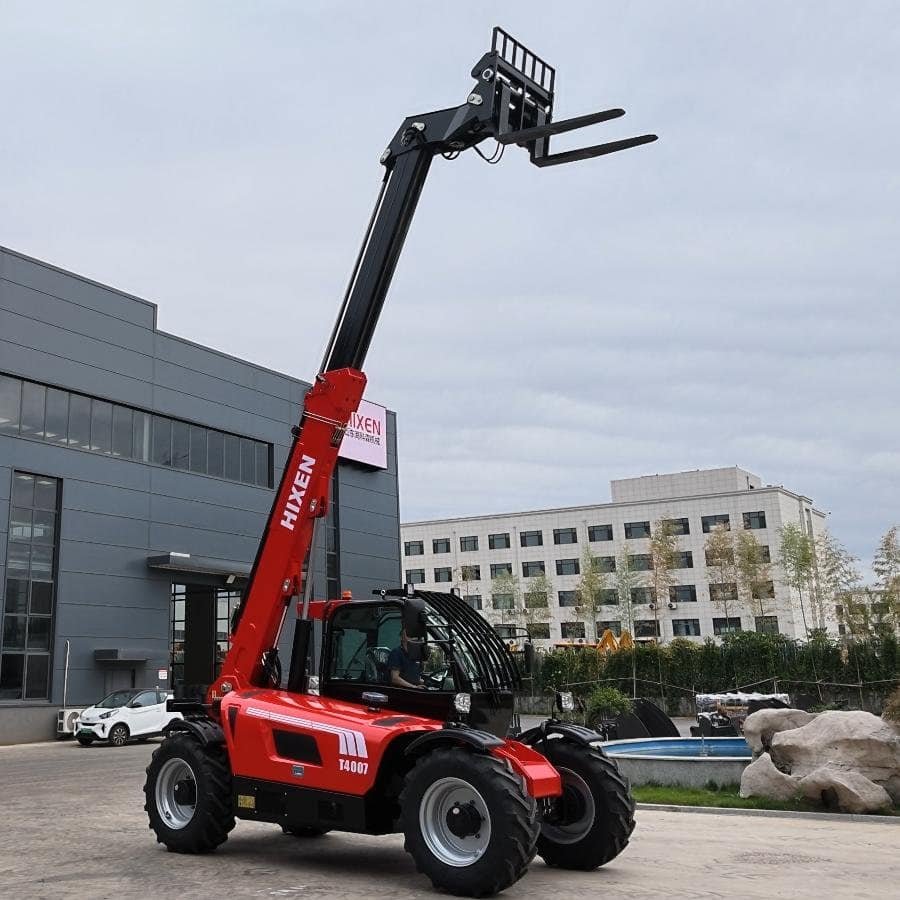
This capability is what unlocks the true return on investment for a fixed telehandler, turning a single capital expense into a multi-functional solution.
Dive Deeper: The Right Tool for Every Job
When consulting with customers, I always emphasize that they should think about the jobs they need to do first, and the attachments second. This ensures they get a complete solution, not just a machine. At HIXEN, we can configure a fixed telehandler with a package of attachments tailored to a client’s specific industry.
Here are some of the most common attachments and their uses:
Fourches à palettes
This is the standard, most-used attachment. It’s perfect for lifting and moving palletized goods, just like a forklift. This is essential for handling bricks, sod, bagged materials, and nearly anything else delivered on a pallet.
Seau
A bucket attachment transforms your telehandler into a powerful loader. It’s ideal for moving loose materials like:
- Sand, gravel, and soil on a construction site.
- Grain, feed, and silage on a farm.
- Snow during winter clearing operations.
- General site debris.
Bale Clamp
An essential tool for agriculture. The bale clamp (or bale grab) is designed to securely grip round or square bales without damaging the wrapping, allowing for safe and efficient stacking.
Jib and Lifting Hook
This attachment turns your fixed telehandler into a mini-crane. The jib extends the reach even further and provides a hook point for lifting non-palletized, suspended loads like engines, roof trusses, or large pipes.
Work Platform
Also known as a man basket, this attachment allows you to safely lift personnel to perform work at height. It’s used for building maintenance, window installation, tree trimming, and inspections.
Important Safety Note: Always use a work platform that is specifically designed and approved for your telehandler model. The machine must have the correct safety features enabled, and operators must follow all local regulations and manufacturer guidelines. The load capacity for a work platform is different from the machine’s material lifting capacity.
7,How to Choose the Right Fixed Telehandler?
Ready to invest in a fixed telehandler? The selection process can seem daunting with so many models and options available. A systematic approach will ensure you get the machine that best fits your needs and budget.
To choose the right fixed telehandler, you must first define your requirements for lifting capacity and height, check the load chart, select a suitable engine and attachments, and finally, evaluate the supplier’s after-sales support.

Following these steps will help you make a confident and well-informed purchasing decision.
Dive Deeper: A 7-Step Buyer’s Guide
As a manufacturer, we want our customers to be happy with their purchase for years to come. That’s why I always walk them through this seven-step evaluation process.
Step 1: Determine the Required Lifting Capacity
Start with the heaviest load you need to lift regularly. Fixed telehandlers are commonly available in capacities from 2.5 tons to 6 tons. Choose a capacity that safely exceeds your maximum load, but remember this is just the starting point.
Step 2: Choose the Right Lifting Height and Forward Reach
How high do you need to lift? How far forward do you need to reach? A farm stacking hay might prioritize lift height, while a construction site placing materials inside a building may need more forward reach. Define your typical maximum working envelope.
Step 3: Check the Load Chart
This is the most critical step. The maximum lift capacity only applies when the boom is retracted and at a specific angle. The load chart shows you exactly how much the machine can safely lift at any combination of height and reach. Always ask for the load chart and confirm it meets your needs throughout the entire working range.
Step 4: Select the Right Engine
Consider the engine brand (e.g., Cummins, Perkins, Yuchai) and, most importantly, the emissions standards required in your country (e.g., Euro V, Tier 4F). Choosing a reputable engine brand ensures better reliability and easier access to service parts.
Step 5: Consider the Hydraulic System and Transmission
The quality of the hydraulic system determines the smoothness and precision of the boom’s operation. Likewise, the transmission and axles affect the machine’s driving performance and durability. Discuss these component options with the supplier to match them to your expected workload.
Step 6: Choose the Necessary Attachments
Think about all the jobs you want the machine to do and list the attachments you’ll need. It’s far more cost-effective to order these with the machine rather than sourcing them later. Ensure the attachments are compatible and certified for your chosen model.
Step 7: Consider After-Sales Support
A machine is only as good as the support behind it. Before buying, ask about:
- Warranty period and coverage.
- Availability and shipping of spare parts.
- Access to technical support and documentation (operation manuals, maintenance guides).
- Training for your operators and service technicians.
8,Fixed Telehandler by Lifting Height: 7m, 10m, 14m or 18m?
One of the most common ways to categorize a fixed telehandler is by its maximum lifting height. This metric directly relates to the types of jobs a machine can accomplish.
Choosing the right lifting height—whether 7m, 10m, 14m, or 18m—depends on your primary application. A 7m model is great for general agriculture and low-rise construction, while 14m and 18m models are required for multi-story building projects.

Let’s look at the typical applications for each common height class to help you narrow down your choice.
Dive Deeper: Matching Height to Your Job
While the options are numerous, most needs fall into one of these categories. Remember that maximum lifting height does not equal maximum forward reach, and lifting capacity decreases as you reach higher. At HIXEN, we offer a range of models, such as the HX3007 (3-ton, 7m) and the HX4018 (4-ton, 17.6m), to cover these diverse needs.
| Max. Lifting Height | Common Applications & Environment |
|---|---|
| 7 meters (23 ft) | Ideal for most agricultural tasks (hay stacking, loading), single-story construction, landscaping, and warehouse yard work. This is often the most popular and versatile category. |
| 10 meters (33 ft) | A great all-rounder for two-to-three-story construction projects, placing materials on roofs, and high-stacking in large agricultural sheds or warehouses. |
| 14 meters (46 ft) | Suited for medium-rise construction (up to four or five stories), industrial maintenance, and jobs requiring significant reach over obstacles. |
| 18 meters (59 ft) | A specialized machine for larger construction projects, bridge work, and applications where maximum vertical reach is the primary requirement. |
Pro Tip: Don’t overbuy. A machine with excessive height capability will be larger, heavier, and more expensive. It may also be less maneuverable in tighter spaces. Carefully analyze your most frequent tasks. I’ve often advised clients that a 10m or 14m machine with excellent forward reach is more useful for them than an 18m machine they will rarely use to its full height. Always refer back to the load chart to see the full picture of a machine’s capability.
9,How Much Does a Fixed Telehandler Cost?
After defining your technical requirements, the next logical question is about the budget. How much should you expect to invest in a new fixed telehandler?
The cost of a fixed telehandler is not a single figure; it is influenced by a wide range of factors including its lifting capacity, height, engine brand, configuration, and included attachments. A direct, factory quote is the only way to get an accurate price.

While I cannot provide a universal price list, I can explain the key variables that determine the final cost. Understanding these will help you compare quotes effectively.
Dive Deeper: Factors That Influence the Price
When you request a quote from us or any other supplier, the price will be built based on these ten key factors:
- Lifting Capacity: A 5-ton machine will cost more than a 3-ton machine due to a stronger boom and chassis.
- Lifting Height: Longer booms with more telescopic sections require more complex engineering and materials, increasing the price. An 18m model costs significantly more than a 7m model.
- Engine Brand and Emissions: A premium engine from a brand like Cummins or Perkins, especially one compliant with strict Tier 4F or Euro V emissions standards, will be more expensive than a standard engine for a less regulated market.
- Hydraulic System: High-end, load-sensing hydraulic systems offer better performance but come at a higher cost than simpler gear pump systems.
- Transmission and Axles: The choice of transmission and axles affects both performance and price.
- Cab Configuration: An enclosed cab with air conditioning, heating, and ergonomic controls will cost more than a basic open canopy.
- Attachments: The number and type of attachments included in the package will directly add to the total cost.
- Brand and Manufacturing Quality: Established brands with a reputation for quality, durability, and support often command a higher price.
- New vs. Used: A used fixed telehandler will be cheaper upfront, but may come with higher maintenance costs and no warranty. A new, factory-direct machine provides the latest technology and full support.
- Shipping and Incoterms: The final delivered price will depend on shipping costs to your destination port and the agreed-upon trade terms (e.g., FOB, CIF).
When comparing quotes from different suppliers, ensure you are comparing machines with identical specifications across all these points. A cheaper price might mean a lower-spec engine, a more basic cab, or fewer included attachments. Always ask for a detailed specification sheet with your quote.
10,Fixed Telehandler vs Forklift vs Wheel Loader
Is a fixed telehandler always the right choice? If your work also involves tasks typically done by forklifts or wheel loaders, it can be hard to decide which machine offers the best value.
The choice between a fixed telehandler, a forklift, and a wheel loader depends on your primary task. A forklift excels at pallet handling on smooth surfaces, a wheel loader is best for bulk material loading, and a telehandler provides unparalleled lifting height and forward reach.

Let’s compare these three workhorses to help you identify the best fit for your operations.
Dive Deeper: Choosing the Right Tool for the Job
Each machine is designed with a primary purpose in mind. Trying to make one machine do everything can lead to inefficiency and even safety risks.
| Machine | Primary Advantage | Best Use Cases | Key Limitation |
|---|---|---|---|
| Fixed Telehandler | Telescopic boom for height and reach | Construction, agriculture, multi-tasking | Less maneuverable than a forklift in tight indoor spaces |
| Chariot élévateur | Efficiency and maneuverability | Warehouses, factories, paved surfaces | Limited lift height and poor on rough terrain |
| Wheel Loader | High-volume scooping and loading | Quarries, sand/gravel pits, large-scale earthmoving | Poor at precise placement and pallet handling |
When to Choose a Forklift
If your daily work consists almost entirely of moving pallets inside a warehouse or on paved factory floors, a forklift is the most efficient and cost-effective tool. It’s smaller, more maneuverable in tight aisles, and typically less expensive to purchase and operate.
When to Choose a Wheel Loader
If your primary job is to scoop and load massive volumes of loose materials—like gravel into a crusher or dirt into a dump truck—a wheel loader is the undisputed champion. Its large bucket capacity and powerful breakout force are designed specifically for this purpose.
When to Choose a Fixed Telehandler
UN fixed telehandler is the solution when you need versatility. Choose it if your job involves:
- Lifting materials to a second story or higher.
- Reaching over obstacles to place a load.
- Working on uneven, muddy, or rough terrain.
- Needing a single machine to handle forks, buckets, and other attachments.
The core takeaway is this: Choose the machine based on the work you do most often, not simply on the number of functions it offers. If 80% of your day is lifting pallets, buy a forklift. If 80% is loading dirt, buy a wheel loader. If your day is a mix of lifting high, driving on rough ground, and moving different materials, the fixed telehandler is your answer.
11,HIXEN Fixed Telehandler: Practical Lifting Solutions for Different Industries
Now that you have a comprehensive understanding of what a fixed telehandler can do, you might be wondering where to find a reliable and well-equipped machine.
As a direct manufacturer with over 15 years of experience, we at HIXEN specialize in developing, producing, and exporting a wide range of fixed telehandlers. Our focus is on providing practical, durable, and cost-effective lifting solutions for customers in construction, agriculture, and various industrial sectors worldwide.
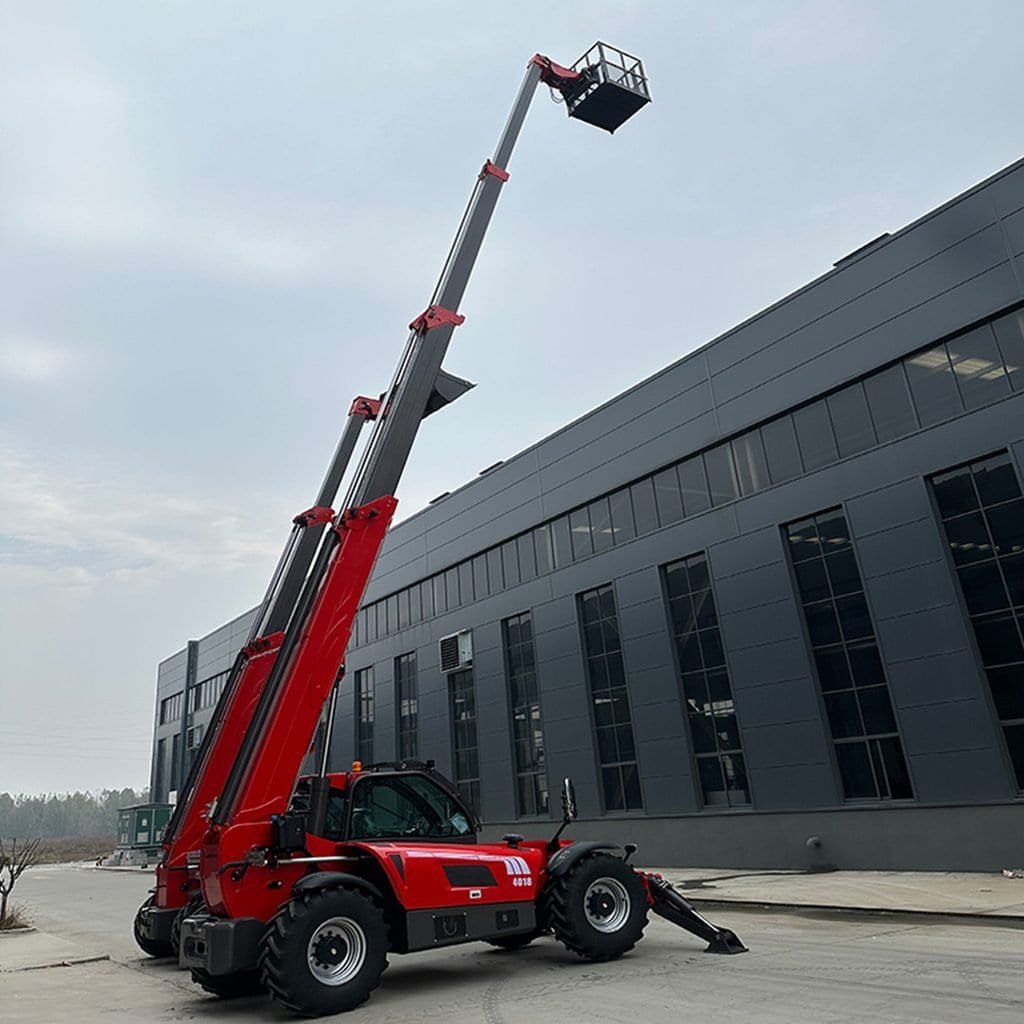
We believe in providing not just a machine, but a complete solution tailored to your specific operational needs.
Dive Deeper: The HIXEN Advantage
Our goal is to be more than just a supplier; we aim to be a long-term partner for our clients, who are primarily equipment dealers, construction firms, and agricultural enterprises.
1. Direct Manufacturer, Global Experience
We are not a trading company. We design and build our machines in-house, giving us full control over quality and production. With experience exporting to over 50 countries, we understand the demands of different markets and applications.
2. Multiple Models for Diverse Needs
We offer a comprehensive lineup of fixed telehandler models to ensure you can find the perfect match for your requirements:
- Compact models: HX2506 (2.5T, 6m)
- Versatile 7m models: HX3007 (3T), HX3507 (3.5T), HX4007 (4T)
- High-reach models: HX3510 (3.5T, 10.5m), HX4014 (4T, 14m), HX4018 (4T, 17.6m)
- Heavy-duty models: HX5010 (5T, 10m), HX5014 (5T, 14m), HX5018 (5T, 17.6m)
3. Flexible Engine and Component Options
We offer a range of engine options, including Cummins, Perkins, Yuchai, and more, configured to meet the specific emissions standards of your region. We can also customize hydraulic and transmission components to balance performance and budget.
4. Complete Attachment Solutions
UN fixed telehandler is only as good as its attachments. We provide a full suite of factory-fitted tools, including forks, various buckets, bale clamps, jibs, lifting hooks, and safety-certified work platforms, ensuring your machine is ready to work from day one.
5. Full Export and After-Sales Support
We provide comprehensive support for our international clients, including detailed technical documentation, reliable spare parts supply, warranty coverage, and remote technical assistance to help you keep your equipment running smoothly.
Our team is dedicated to helping you analyze your work environment, lifting requirements, and budget to configure the most practical and valuable fixed telehandler solution for your business.
Frequently Asked Questions About Fixed Telehandlers
What is the main difference between a fixed and rotating telehandler?
A fixed telehandler has a rigid chassis, and the entire machine must be moved to change the boom’s position. A rotating telehandler has a 360-degree rotating upper structure, allowing it to work in a full circle from a stationary position, similar to a crane.
Is a fixed telehandler better than a forklift?
It depends on the job. A fixed telehandler is better for lifting to significant heights, reaching forward, and operating on rough terrain. A forklift is more efficient and maneuverable for moving pallets on smooth, level surfaces like inside a warehouse.
What should I check before buying a fixed telehandler?
Always check the lifting capacity, maximum lifting height, and forward reach. Most importantly, review the machine’s load chart to ensure it can handle your specific loads at the required heights and distances. Also, verify engine specifications, available attachments, and the supplier’s after-sales support.
How high can a fixed telehandler lift?
Commercially available models offer a wide range of lift heights. Common options include 7 meters (23 ft), 10 meters (33 ft), 14 meters (46 ft), and 18 meters (59 ft). The right choice depends entirely on your specific job site requirements.
What attachments are most common for a fixed telehandler?
The most common attachments are pallet forks for handling materials, buckets for moving loose materials like sand or gravel, and bale clamps for agricultural use. Jibs, hooks, and work platforms are also widely used to extend the machine’s versatility.
Conclusion
Le fixed telehandler has firmly established itself as one of the most versatile and valuable machines in modern construction and agriculture. By combining impressive lifting height, crucial forward reach, and rugged all-terrain performance, it solves everyday material handling challenges with unparalleled efficiency. From understanding the critical importance of a load chart to choosing the right attachments, selecting the right machine comes down to a clear analysis of your specific tasks. The right fixed telehandler can consolidate the roles of multiple machines, saving you time, labor, and operational costs.
If you are a global dealer, importer, or business looking to enhance your operational capabilities, exploring a fixed telehandler is a logical next step. Our team at HIXEN is ready to help you navigate the options and configure a machine that perfectly matches your project needs and budget.
Contact our team today to discuss your requirements and receive a customized quote for a HIXEN fixed telehandler solution.
