
Do you not know what is a telehandler is? You’re not the only one. A lot of buyers have trouble figuring out how to use it, what its benefits are, and if it meets their needs.
A telehandler, also called a telescopic handler, is a flexible lifting machine with a boom that can move forward and up. It does the jobs of both a forklift and a crane and is often used in construction, farming, and storage.
Let’s look at what makes this machine so helpful and see if it’s right for your job.
What Is A Telehandler Used For?
Telehandlers are commonly seen on construction sites, farms, and warehouses, but what exactly do they do?
A telehandler is used to lift, move, and place heavy materials in hard-to-reach areas, thanks to its extendable boom and attachment flexibility.
These machines can safely operate on rough terrain, stack pallets at height, transport loads over obstacles, and even perform light-duty crane work. Whether lifting bricks to upper floors or stacking hay in barns, a telehandler offers unmatched versatility. This explains why it’s a preferred choice among operators seeking adaptable equipment.

What Are The Benefits Of A Telehandler?
What are the benefits of using a telehandler instead of other lifting machines? Let’s take a look at what makes it special.
A telehandler is a versatile machine that can reach, lift, and carry heavy loads all at the same time. This makes it perfect for job sites that are always changing.
It can work on uneven ground and reach higher places with different attachments, unlike a regular forklift. For example, our telehandlers can lift 4 to 6 tons and have a boom reach of 7 to 18 meters, which makes them good for tough jobs in construction and farming. One machine can do a lot of things.
What Is The Difference Between A Forklift And A Telehandler?
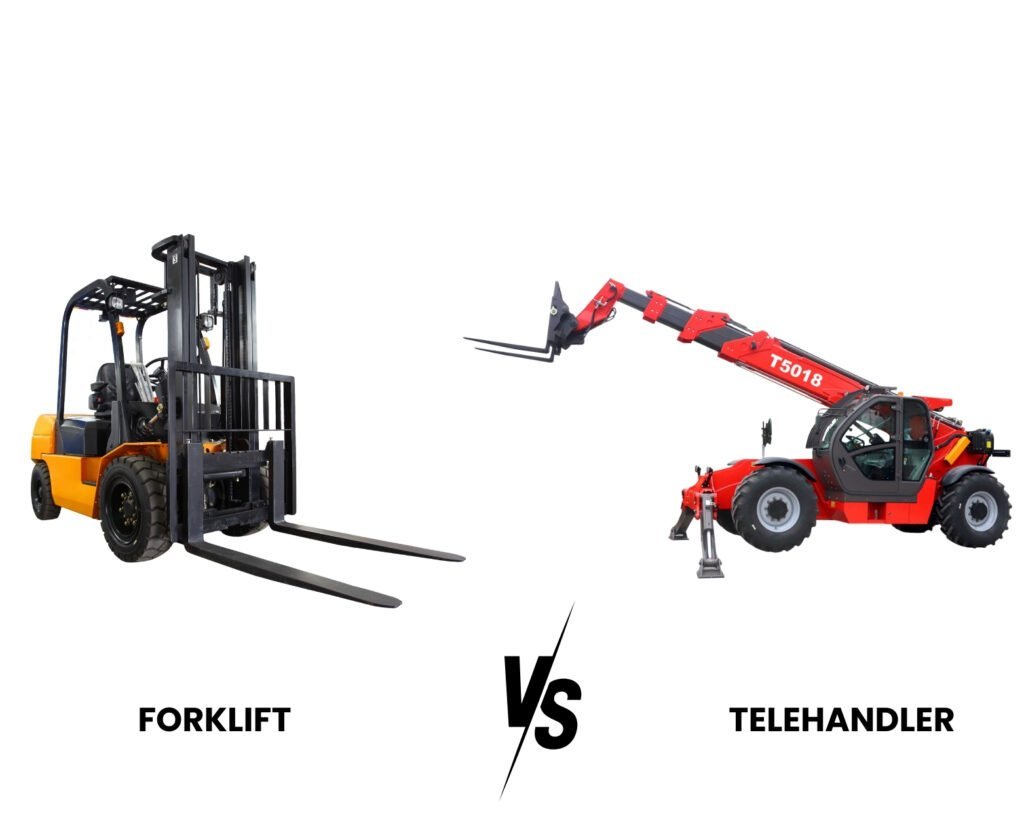
Not sure yet how a telehandler is different from a regular forklift? Let’s take it apart.
The main difference is that the telehandler’s boom can be extended, which lets it reach up and out, while a forklift can only lift straight up.
Here’s a quick look at the differences:
| Recurso | Forklift | Telehandler |
|---|---|---|
| Lift Direction | Vertical only | Vertical and telescopic reach |
| Terrain Suitability | Flat surfaces only | Rough and uneven terrain |
| Load Capacity | Moderate | Higher (up to 6 tons) |
| Reach Height | Limited | Up to 18 meters (with our models) |
| Attachment Options | Limited | Wide range (forks, buckets, hooks) |
| Common Use | Warehouses, indoor transport | Construction, agriculture, outdoor |
As you can see, a telehandler is built for more complex, outdoor, and high-reach jobs—perfect for evolving site demands.
How Does A Telehandler Work?
Behind the telehandler’s strength and versatility is an intelligent design powered by hydraulics.
A telehandler operates with a telescopic boom controlled by a hydraulic system, allowing the operator to extend, lift, and angle loads precisely.
Operators use joystick controls to raise or retract the boom, tilt the load, and steer across rugged terrain. Stabilizers or outriggers enhance balance during high lifts. The cabin design ensures clear visibility for precision work, making operation both safe and efficient.

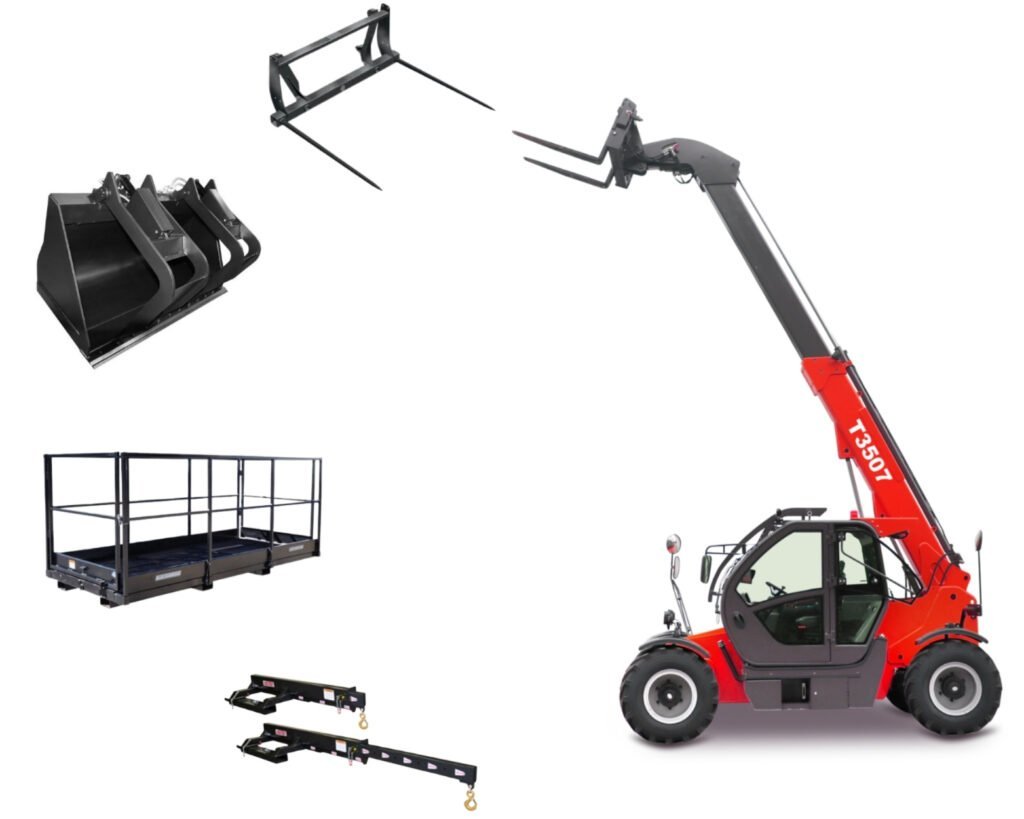
What Attachments Are Available For A Telehandler?
What makes telehandlers truly powerful? The right attachment. Let’s explore some of the most common options.
Pallet Forks
For basic lifting and transporting of palletized goods, pallet forks are the go-to.
Pallet forks enable your telehandler to perform traditional forklift tasks with added height and reach.
Ideal for loading trucks or moving pallets on uneven terrain, they are a standard attachment for most telehandler users—especially in logistics and warehousing sectors.
Buckets
Used for material handling such as soil, sand, or gravel.
Bucket attachments convert your telehandler into a front loader—excellent for bulk material transfer.
Operators in construction or landscaping favor this attachment to reduce the need for separate earth-moving equipment.
Lifting Hooks
Need to lift irregular loads like pipes or beams? A lifting hook fits the job.
Hooks turn your telehandler into a light-duty crane, suitable for vertical lifts.
It’s ideal for construction sites that need to move suspended materials, offering a low-cost lifting alternative.
Grapples
When handling loose or awkward loads like logs, scrap, or hay bales, grapples are essential.
Grapples provide grip and control, helping you move irregularly shaped or bulk items securely.
Especially popular in forestry and farming applications, they add a new dimension to your machine’s utility.
Jib Boom
The jib boom attachment is used for precise, high-reach lifting.
Jib booms extend the telehandler’s reach, enabling accurate placement of suspended loads.
For steel construction or roof truss placement, this attachment adds extra reach and flexibility to your telehandler’s performance.
How To Choose The Right Telehandler?
Buying the right telehandler means matching its specs to your job site needs.
Choose based on your lifting height, load weight, terrain type, and attachment requirements.
Start by defining your maximum load and highest reach. For example, our 4–6 ton, 7–18 meter range models serve medium to heavy-duty applications. Also consider machine size, maneuverability, and available attachments. We’re here to help guide your selection process.
Resumo
Still unsure which model fits your project? Contact us now—we’ll recommend the best telehandler for your needs and budget.
