
Excavation collapse is a silent killer—unseen, but deadly. Avoid delays and injuries with benching, a safety method every builder should know.
Benching excavation involves cutting the sides of an excavation into horizontal steps to prevent soil collapse and protect workers. It’s a key safety practice approved by OSHA and ideal for stable soil conditions.
Keep reading to learn how to use benching safely and effectively.
What Is Benching Excavation?
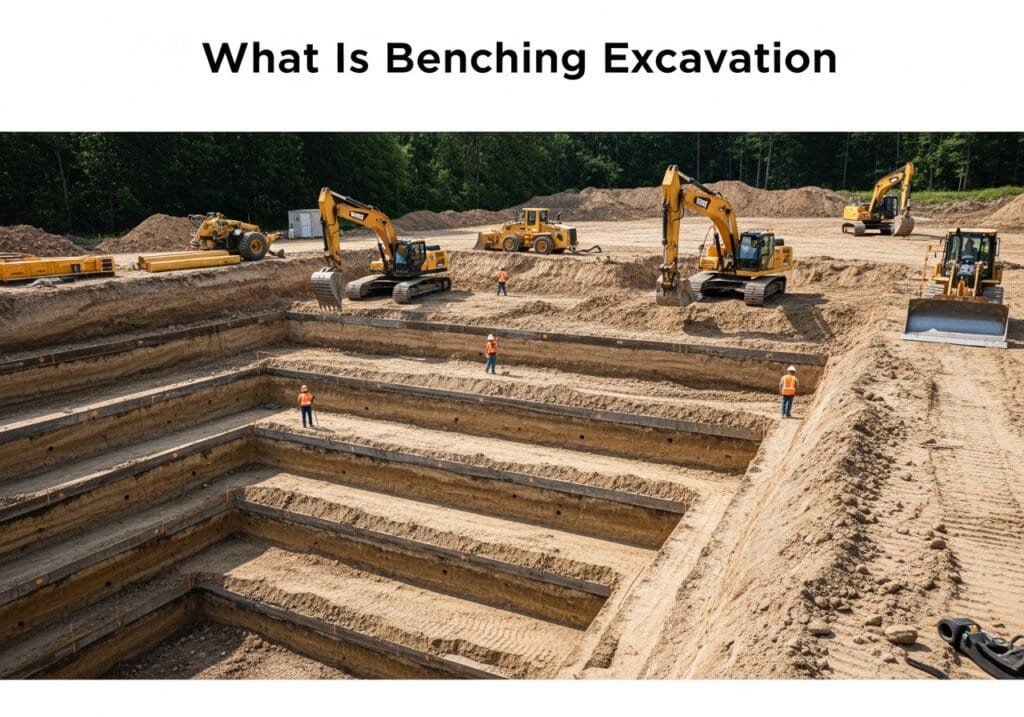
Benching is an excavation safety technique where the walls of a trench or pit are cut into horizontal steps instead of left vertical. This approach helps reduce soil pressure, preventing collapse.
Benching is a step-shaped method of soil support, creating flat, horizontal levels along trench walls to reduce the chance of soil cave-ins.
It’s often used in wide construction areas where space allows, and the soil is stable. This method differs from shoring excavation, which uses mechanical supports, and sloping excavation, which uses angled walls. Depending on the site, benching can be used alone or with other methods.
Why Is Benching Important in Excavation?
Benching isn’t just about safety—it’s about saving time, money, and lives. Every trench deeper than 5 feet needs protection, and benching is a widely accepted solution.
Benching protects workers from trench collapses, supports soil stability, and meets regulatory safety requirements such as OSHA standards.
Without proper protection, trench collapses can lead to fatalities and costly project delays. Benching in construction has become a best practice, especially in medium to large-scale projects where wider trenches are possible. Compliance with OSHA not only protects workers but also keeps you legally secure.

What Are the Different Types of Benching Methods?
Different soil types and trench depths require different benching styles. Choosing the wrong method can be dangerous.
Benching methods include single-level benches, multiple-level benches, and straight-cut benches, depending on trench depth and soil type.
Here’s a quick comparison of common benching methods:
| Benching Type | Description | Suitable Soil Type | Max Vertical Height |
|---|---|---|---|
| Single-Level Benching | One horizontal cut or step | Type A or B | Up to 4 ft (1.2 m) |
| Multiple-Level Benching | Several horizontal steps stacked vertically | Type A or B | Varies per step |
| Straight Cut (Unsupported) | Vertical wall with minimal or no benching | Only Type A (Stable Rock) | Not Recommended |
| Sloped Benching Combo | Benching with sloped walls above final step | Type B or C | Depends on angle & depth |
For example, Type A soils (clay, stable rock) can support steeper, higher benches. For Type C soils (granular, loose), sloped benching or even shoring may be safer. When using heavy equipment like CAT excavators, proper benching ensures both operator safety and trench integrity.
Planning and Preparing for Benching Excavation
A well-executed benching system begins long before digging starts. Planning is key to safety.
Start by conducting soil classification, checking local regulations, and creating a benching plan that matches site conditions.
A professional engineer is often required for trenches deeper than 20 feet. Planning also includes choosing the right equipment—such as a CAT or KOMATSU excavator—to ensure precision. Consider downloading a benching excavation PDF guide from OSHA or local authorities before starting work.
What Is the Difference Between Shoring and Benching?
Choosing between shoring and benching can be confusing, especially on tight job sites or with unstable soil. Each has unique use cases and advantages.
Shoring uses mechanical supports to hold trench walls vertically, while benching creates horizontal steps to reduce collapse risk naturally.
- Shoring involves installing hydraulic, timber, or aluminum supports to reinforce the trench wall, making it ideal for confined spaces or unstable soils.
- Benching, on the other hand, requires space and works best in stable soils where a safe angle of repose can be achieved. In cities or utility work, shoring is common due to space limits. In open fields or construction sites, benching is often more cost-effective and faster.

What Are the Safety Considerations for Benching Excavation?
Even with benches, excavation remains high-risk if not properly managed.
Always inspect trench walls for soil movement, never exceed bench height limits, and ensure equipment is operated by trained personnel.
Regulations like OSHA’s 1926 Subpart P set standards for benching based on soil type and trench depth. Regular on-site checks and daily logs are recommended. For used machine users, ensure your equipment (like a Hyundai skid steer loader) has no hydraulic or braking issues before entering trenches.
Common Mistakes to Avoid when Conducting Benching Excavation
Even experienced crews make avoidable errors—usually by ignoring the basics.
Skipping soil tests, exceeding step heights, or using improper machines can lead to collapse or regulatory violations.
Avoid assuming all soils behave the same. A benching excavation example in hard clay will fail in sandy soil. Also, never try to modify benches during excavation without proper recalculations. Using the wrong equipment—say, an oversized loader in a narrow trench—can compromise the whole structure.
Résumé
Benching saves lives, money, and time—when done right. Respect the soil, follow the rules, and dig smart.
