
If you’re undecided between tracked vs wheeled skid steer loaders, this blog can answer your questions. Let’s analyze their advantages and disadvantages to help you make a quick decision.
Wheeled skid steer loaders are suitable for hard, flat ground and have lower maintenance costs; while tracked skid steer loaders offer better stability and traction on soft, rough terrain. Your choice should depend on ground conditions, climate, and budget.
Below is a detailed comparative analysis to help you make the right choice based on your actual work needs.
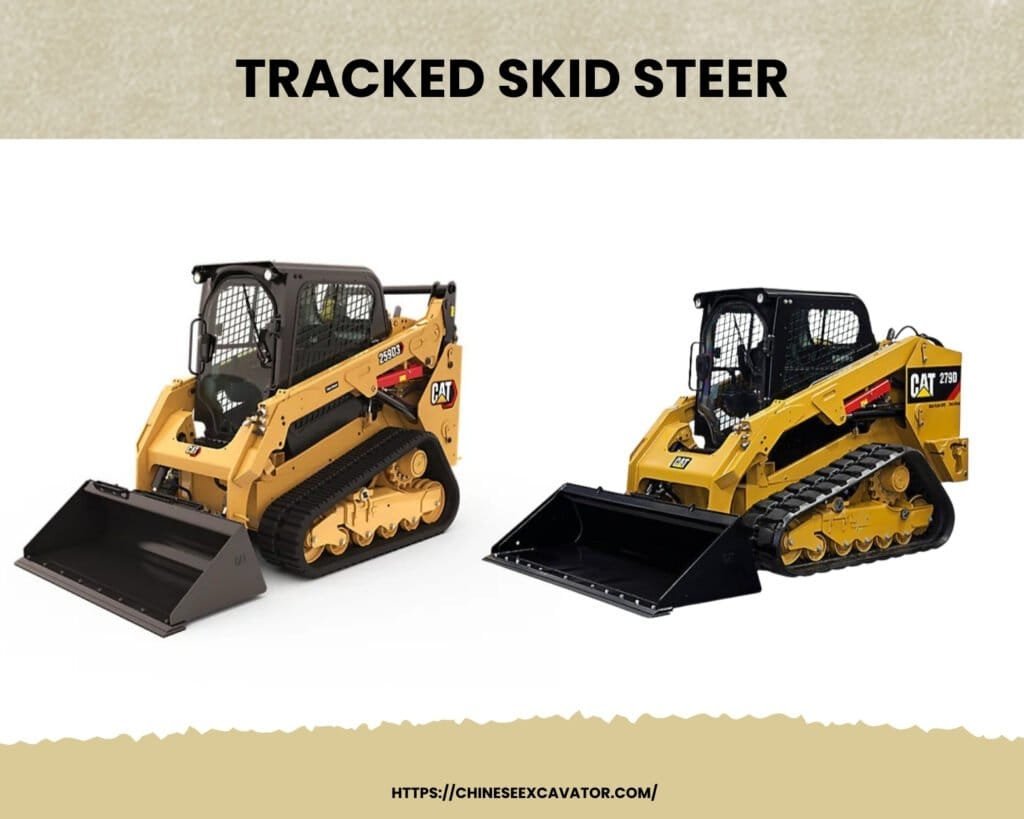
Tracked Skid Steer
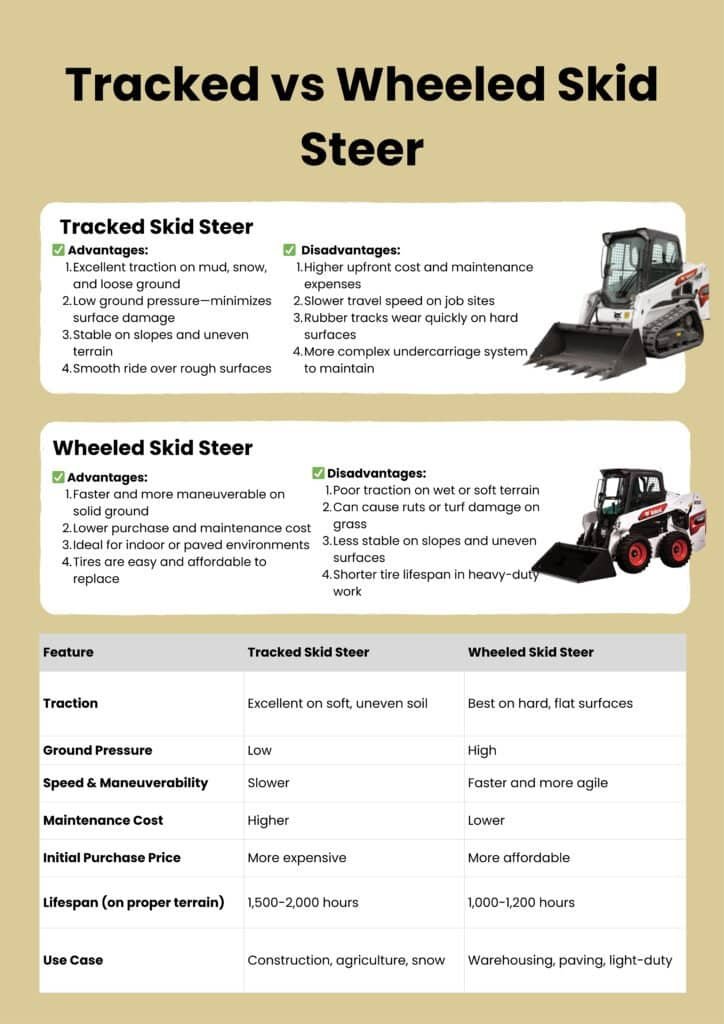
Advantages
Tracked skid steers are made to work in tough conditions. If you often work on muddy, sandy, or uneven ground, a tracked unit will give you the stability and grip you need.
Tracked skid steers are great for tough job sites and year-round work because they have better traction, stability, and floatation on soft or uneven ground.
Tracked models like the Caterpillar 279D3 and Kubota SVL75-2 are made to make the most contact with the ground. This lowers ground pressure and protects fragile surfaces. Their tracks lower their center of gravity, which makes them safer on sloped ground. You can find them a lot in the landscaping, forestry, demolition, and snow removal industries.
Disadvantages
Though powerful, tracked skid steers aren’t always the most practical option—especially if you’re managing costs.
Tracked skid steers cost more upfront, require more maintenance, and move slower compared to wheeled models, which could affect productivity on large flat sites.
Replacing rubber tracks can be expensive, and the undercarriage system is more complex. For example, tracks are more susceptible to wear when operated frequently on hard concrete or asphalt. You’ll also need to budget for regular tension adjustments and track replacements.
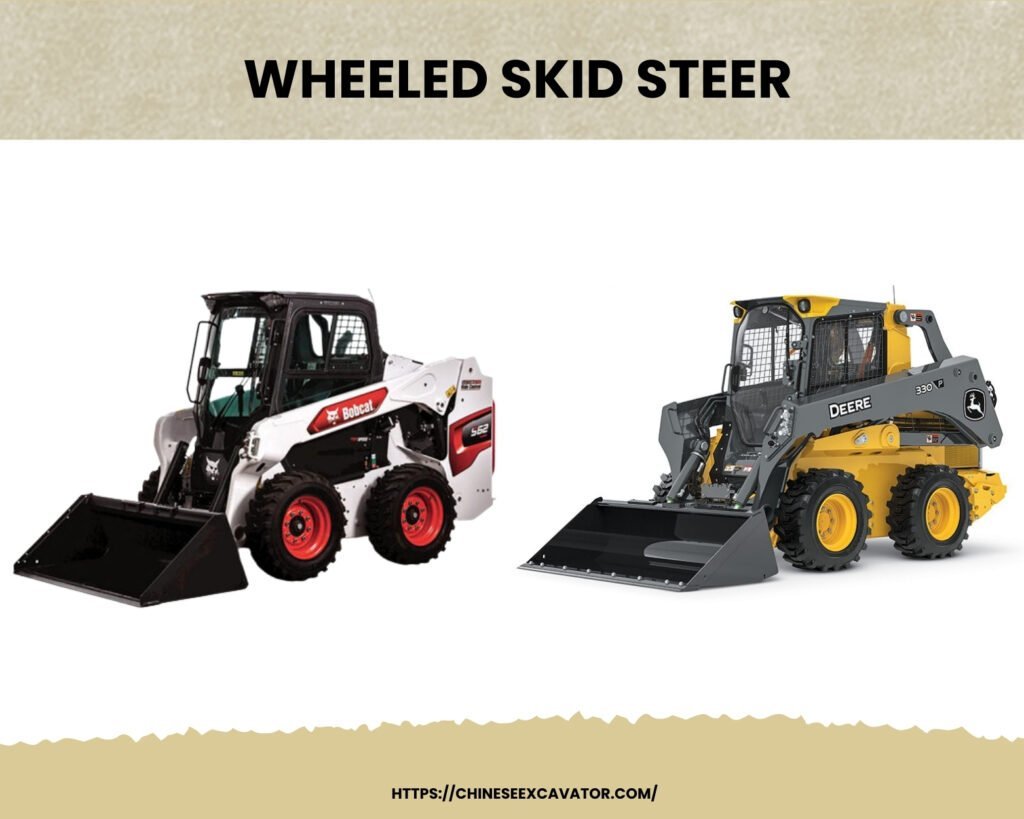
Wheeled Skid Steer
Pros
Wheeled skid steers are the best choice for jobs on solid ground, like roads, parking lots, and the insides of buildings.
Wheeled skid steers are usually less expensive, faster, and easier to take care of. They do very well on hard, dry, and flat ground and can easily move around in small spaces.
People like the Bobcat S650, CASE SR210B, and New Holland L320 because they are quick and easy to move. Their tires make them better for cities and factories where they need to be able to move around easily and keep costs low. It also costs less and takes less time to change tires than rubber tracks.
Cons
However, wheeled skid steers do have performance limits—especially when conditions get muddy or uneven.
Wheeled models have less traction, poor performance on soft soil, and can cause more surface damage than tracked machines in certain conditions.
Their limited ground contact means higher ground pressure, which may cause them to sink or spin in mud, snow, or loose sand. Using a wheeled model for snow removal or on a farm field with irregular ground is likely to reduce efficiency.
Tracked vs Wheeled Skid Steer: Key Differences
Choosing between a tracked or wheeled skid steer comes down to understanding the specific differences. Here’s a side-by-side comparison:
| Característica | Tracked Skid Steer | Wheeled Skid Steer |
|---|---|---|
| Traction | Excellent on soft/uneven terrain | Better on flat, solid ground |
| Speed & Maneuverability | Slower; wider turning radius | Faster; tight turning, ideal for confined areas |
| Presión del suelo | Lower – less damage to turf | Higher – may cause rutting |
| Initial Cost | Higher | Lower |
| Maintenance | Track replacement costly, more frequent upkeep | Easier tire changes, lower maintenance cost |
| Ride Comfort | Smoother, especially on rough terrain | Bumpy on uneven surfaces |
| Durability on Surfaces | Not ideal for pavement or concrete | Great for indoor and paved surfaces |
| Applications | Landscaping, snow removal, forestry, agriculture | Roads, warehouses, construction sites |
| Top Models | CAT 279D3, Kubota SVL75-2, JD 317G | Bobcat S650, CASE SR210B, NH L320 |
This comparison helps clarify why understanding your job site environment and task load is essential before making a purchase. These factors also directly affect your equipment lifecycle and operational costs—a key concern when searching for a Tracked vs Wheeled Skid Steer for sale.

Best Applications for Each Type
Tracked skid steers shine in:
- Wet, muddy, or snowy job sites
- Heavy-duty construction zones
- Landscaping on delicate ground
- Steep inclines or uneven terrain
- Agriculture (e.g. soil prep, forest land)
Wheeled skid steers are better suited for:
- Urban construction on flat, paved surfaces
- Road work and interior demolition
- Material handling on solid ground
- Daily use with light maintenance budgets
If you’re searching for the right machine for farm use, tracked skid steers offer better performance in soil-heavy environments. Many small-scale farmers prefer wheeled vs tracked mini skid steer options for easier transport and compact jobs.
How Tracked vs Wheeled Skid Steer Work
The main difference is in how they drive and how their undercarriage works:
A system of sprockets and rollers moves the rubber tracks on tracked skid steers. This setup makes the weight even and gives you better grip.
Wheeled skid steers have four wheels that are powered by hydraulic motors. Because they have a smaller contact area, they put more pressure on the ground, which makes it easier to move around on hard surfaces.
Knowing this mechanical difference will help you figure out what kind of work and terrain each type can handle well.
When to Choose a Tracked or Wheeled Skid Steer?
Still debating? Here’s a simple rule of thumb:
- Choose tracked if you work in:
- Mud, snow, loose gravel
- Slopes, forests, or rough land
- Sensitive landscaping areas
- Choose wheeled if you:
- Need fast movement
- Work indoors or on pavement
- Want to reduce your maintenance budget
Also, consider the Tracked vs Wheeled Skid Steer cost when building your fleet. Tracked models usually cost 15–25% more but could save you downtime in the long run if matched with the right work conditions.
Conclusion
In summary, tracked skid steers offer unbeatable traction and floatation for rough, muddy, or uneven terrain, making them perfect for landscaping, agriculture, and snow removal. On the other hand, wheeled skid steers provide faster speed, lower costs, and better performance on flat, hard surfaces—ideal for indoor or urban jobs.
Your decision should be based on the worksite conditions, budget, and how often you expect to use the machine.
If you’re exploring reliable, cost-effective options in either category, HIOSEN specializes in exporting high-quality used skid steers from leading brands like GATO, Bobcat, Kubota, and CASE. With 15 years of industry experience, we’re here to help you make the right choice.
Preguntas frecuentes
Can you put tracks on a wheeled skid steer?
Yes, but over-the-tire tracks provide limited performance. They’re useful for temporary grip but don’t match the stability of a dedicated track system.
Which is better on a skid steer, tracks or wheels?
Depends on the terrain. Tracks are better for soft, uneven surfaces. Wheels are better for speed and maneuverability on solid ground.
What are the disadvantages of track wheels?
High replacement costs, slower travel speeds, and reduced durability on hard surfaces.
Why are tracks better than tires?
Tracks provide better flotation and stability. They’re more versatile in mud, snow, or gravel and cause less turf damage.
