
Telehandlers come in a wide range of sizes, and choosing the right one is often harder than it seems. Whether you’re managing a small construction site or a major industrial project, selecting the right telehandler sizes can impact safety, efficiency, and overall cost. This guide breaks down the different sizes and how to choose the right one.
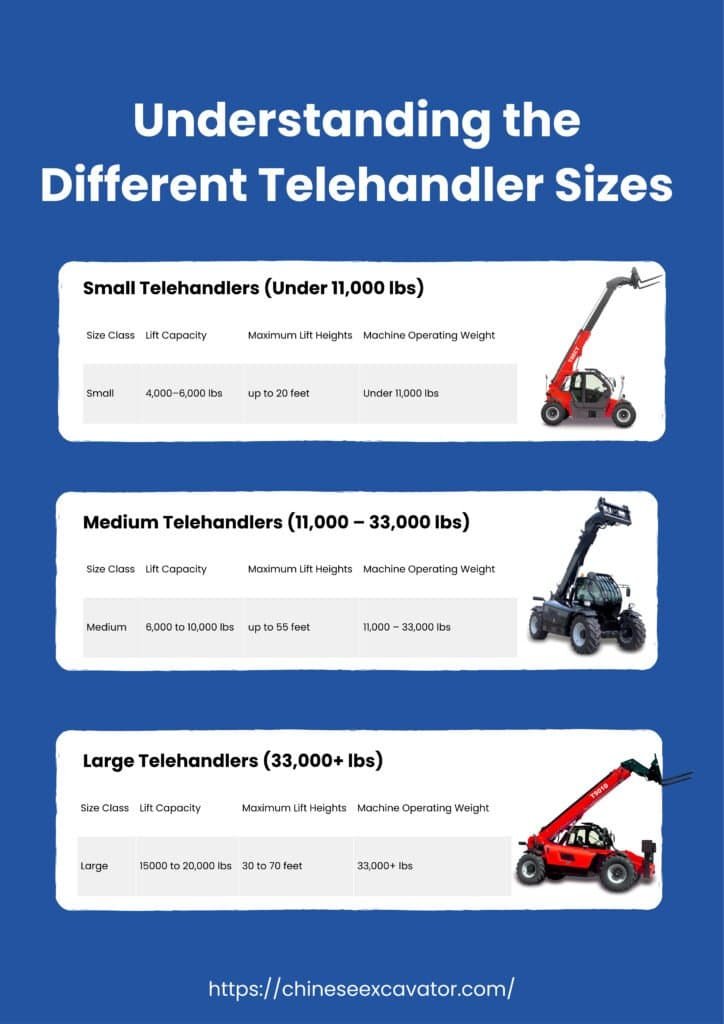
Telehandlers are commonly classified into three size categories based on operating weight and lifting capacity: small/compact (under 11,000 lbs), medium (11,000–33,000 lbs), and large/high-capacity (over 33,000 lbs).
Each type has its own advantages, and the correct choice depends on your specific lifting needs, site conditions, and budget.
Let’s take a deeper look at each telehandler size category.
What Are the Different Sizes of Telehandlers?
Telehandlers are categorized based on machine operating weight, lift capacity, and physical dimensions. Understanding the differences is essential for selecting the right model.
Small Telehandlers (Under 11,000 lbs)
Compact telehandlers are lightweight, maneuverable, and perfect for tight spaces such as small construction sites, agricultural use, and warehouse environments.
These telehandlers usually offer a lift capacity between 4,000–6,000 lbs and maximum lift heights of up to 20 feet.
They are ideal for jobs requiring access through narrow gates or indoor operations with limited space.
Compact models are increasingly popular due to their low operating costs and versatility. Despite their size, many compact telehandlers can handle a full day’s workload on farms or renovation projects. Their small footprint reduces the risk of damage to paved areas and landscaping.
Typical Small Telehandler Specs:
| نموذج | Machine Operating Weight | Max Lift Capacity | Max Lift Height |
|---|---|---|---|
| CAT TH255C | 11,000 lbs | 5,500 lbs | 18 ft |
| Bobcat TL619 | 10,200 lbs | 5,500 lbs | 19 ft |
| JCB 505-20TC | 10,285 lbs | 5,500 lbs | 20 ft |
These machines also boast excellent fuel efficiency and lower maintenance costs, making them a go-to for smaller budgets.
Medium Telehandlers (11,000 – 33,000 lbs)
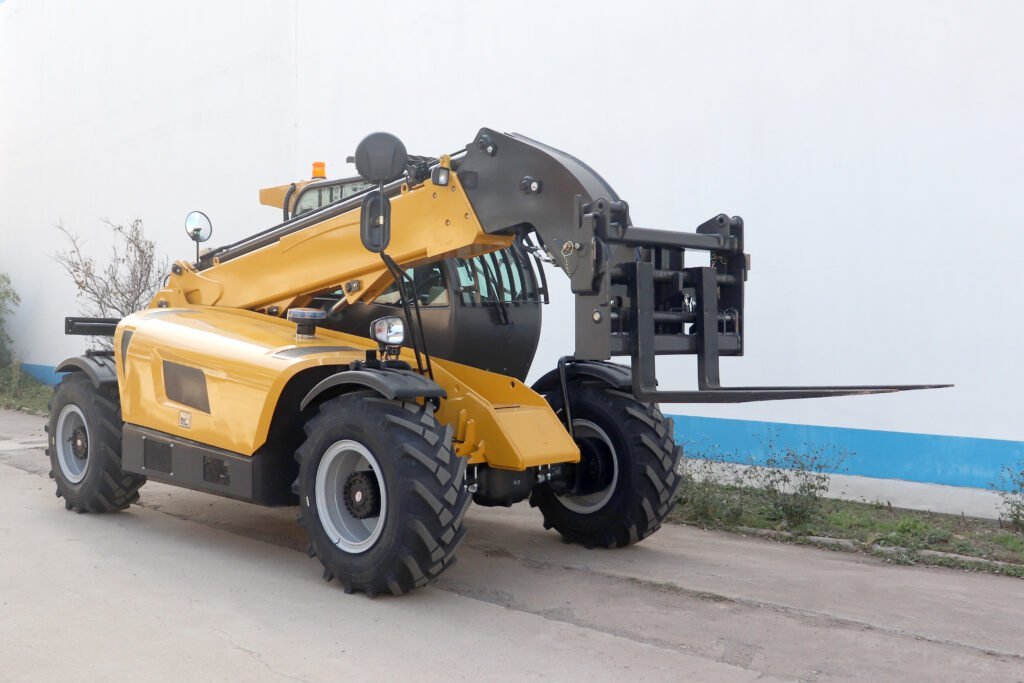
Medium-size telehandlers are the most commonly used in commercial and industrial construction due to their balance of size and power.
Lift capacities in this category range from 6,000 to 10,000 lbs with lift heights up to 55 feet, depending on the model. They offer more stability and versatility than compact models while still maintaining maneuverability.
These machines can be found on almost every medium-to-large construction site, offering both reach and power. Most models also support a wide range of attachments, from buckets to work platforms, further increasing their versatility.
Typical Medium Telehandler Specs:
| نموذج | Machine Operating Weight | Max Lift Capacity | Max Lift Height |
|---|---|---|---|
| CAT TL1055 | 27,500 lbs | 10,000 lbs | 55 ft |
| JLG 1055 | 29,000 lbs | 10,000 lbs | 55 ft |
| Manitou MT 1335 | 20,500 lbs | 7,000 lbs | 43 ft |
These models often feature four-wheel drive and rough terrain tires, making them suitable for uneven job sites.

Large Telehandlers (33,000+ lbs)
For the most difficult lifting jobs, large telehandlers are designed. They are frequently used in high-volume material handling projects, port operations, and mining.
These powerful devices can lift more than 15,000 pounds, and some models can lift up to 20,000 pounds or more.
Depending on the model and attachments, their lift heights usually vary from 30 to 70 feet.
Heavy-duty tires, long booms, and sturdy chassis are characteristics of large telehandlers. Although their size restricts their maneuverability, their unparalleled power and capacity make up for it.
Typical Large Telehandler Specs:
| نموذج | Machine Operating Weight | Max Lift Capacity | Max Lift Height |
|---|---|---|---|
| Manitou MHT 10135 | 66,000 lbs | 30,000 lbs | 31 ft |
| JCB 512-83R | 35,274 lbs | 12,000 lbs | 83 ft |
| Genie GTH-1256 | 33,686 lbs | 12,000 lbs | 56 ft |
These machines are perfect for projects where massive payloads need to be moved efficiently across large sites.
How Much Weight Can a Telehandler Lift?
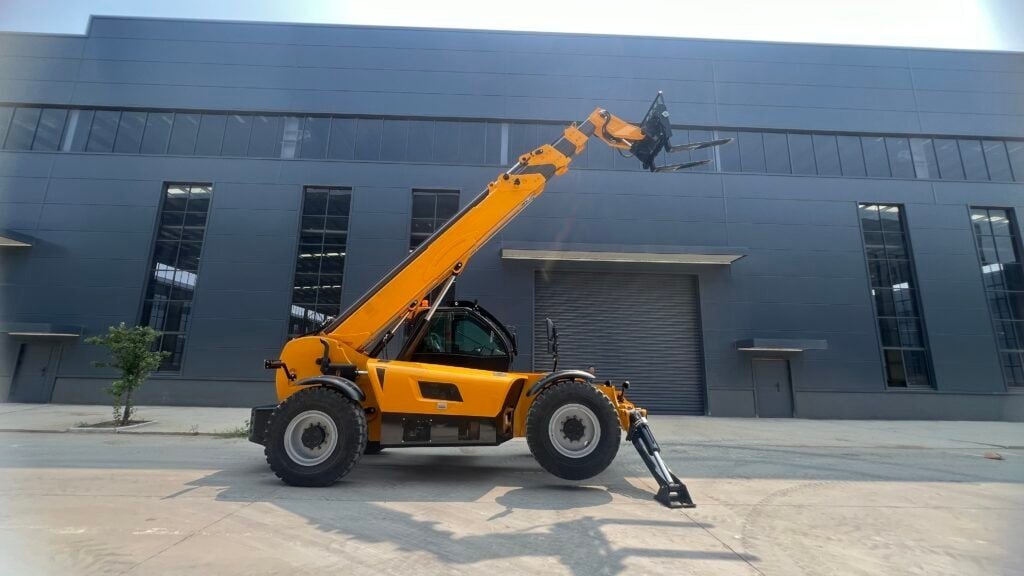
Depending on their size, model, and boom extension, telehandlers can lift between 4,000 and 30,000 pounds.
To avoid overloading, always check the manufacturer’s telehandler capacity chart.
The boom’s lift capacity also goes down as it moves outward or upward. For instance, a telehandler that can lift 10,000 pounds may only be able to lift 3,000 pounds when fully extended. The ability to lift safely can also be affected by the weather, the skill of the operator, and the type of ground.
What Types of Telehandlers Are Available
There are two main types of telehandlers: fixed and rotating.
- Fixed Telehandlers are the most common. Their boom is mounted on a fixed base, making them ideal for forward lifting tasks in construction or agriculture. They’re more affordable and easier to operate.
- Rotating Telehandlers (often called roto telehandlers) have a boom mounted on a rotating turret that can spin 360 degrees.
These machines act like a blend between a crane and a forklift, perfect for confined job sites or when multiple direction access is needed.
Rotating models typically cost more but reduce the need to reposition the machine, saving time on large or tight sites.
What Is the Most Popular Telehandler Brand?
Some of the most trusted telehandler brands worldwide include:
- CAT – Known for durable, high-performance machines with intuitive controls.
- JCB – Offers a wide range of compact and heavy-duty models with strong resale value.
- JLG – Specializes in high-reach and rugged terrain models.
- Manitou – A pioneer in rotating telehandlers.
- Bobcat – Famous for compact and versatile telehandlers.
- Genie – Known for reliable high-capacity models.
How to Choose the Right Telehandler Size for Your Project
Choosing the right telehandler size comes down to four key factors:
- Maximum Load Weight – Know the heaviest object you’ll lift.
- Maximum Lift Height – Determine how high the load needs to be lifted.
- Work Site Conditions – Tight space or rough terrain?
- Attachment Needs – Will you use buckets, forks, or winches?
If you’re working indoors or on tight residential sites, go for a compact model under 11,000 lbs.
For general construction or industrial work, a medium-size telehandler offers the best mix of power and flexibility.
For heavy lifting at ports or mines, choose a high-capacity machine over 33,000 lbs.
ملخص
Telehandler sizes vary widely—knowing your lifting needs, space limits, and job site conditions will help you make the right choice. Contact us for expert advice.
